
Not “recession-proof” — nothing truly is. But food demand behaves fundamentally differently from most business categories when the economy slows down, and that difference is worth understanding properly.
“Recession-proof” gets thrown around too loosely in business content, so let’s be precise about what we actually mean here. No business is completely immune to economic downturns — agriculture included. But food, unlike a lot of what small businesses sell, is something people don’t stop buying when money gets tight. That single structural difference is why agriculture behaves so differently from retail, consumer electronics, or discretionary services during a slowdown, and it’s worth understanding clearly if you’re weighing where to put your capital.
The Economic Concept Behind This: Inelastic Demand
Economists describe food demand as largely “inelastic” — meaning demand doesn’t move much even when income or prices change. Research on Indian food consumption patterns has found that most staple food products remain close to perfectly inelastic in both income and price, meaning households continue buying roughly the same amount of food regardless of economic fluctuation, often cutting back on other spending before they cut back on food itself. Compare that to a category like consumer electronics or fashion retail, where a squeeze on household income shows up almost immediately in reduced spending.
This isn’t a uniquely Indian phenomenon either. Global research on the COVID-19 economic shock found that food consumption was largely unaffected by the sharp GDP declines of 2020, even as far more discretionary categories saw significant drops. People reduce dining out, postpone big purchases, and cut discretionary spending during a downturn — but grocery baskets stay remarkably stable.
What This Looked Like in Practice: 2026’s Numbers
This isn’t just theory — it’s showing up in current economic data. As India’s economy has grown, agricultural and rural demand has increasingly functioned as what economists call a “counter-cyclical stabiliser” — meaning that when global trade softens or urban spending slows, rural consumption anchored in food security and basic demand resilience helps cushion overall economic growth rather than amplifying a downturn. This is a genuine shift from agriculture’s historical role as a source of volatility toward being a stabilising force in the broader economy.
For an individual business owner, this translates into something concrete: a downturn that badly hurts a retail shop selling non-essential goods, or a services business dependent on discretionary corporate spending, tends to leave food demand comparatively untouched. People pause a phone upgrade. They rarely pause dinner.
Being Honest About What This Doesn’t Protect You From
It would be dishonest to stop here without covering the real risks, because agriculture is genuinely not immune to every kind of shock. Individual farmers still face price volatility driven by local supply gluts, weather events, and seasonal oversupply — a bumper capsicum season across a region can still crash your local selling price even while overall food demand stays strong nationally. Climate shocks like erratic monsoons or extreme heat can hit yield regardless of what’s happening in the broader economy. And COVID-19 itself showed that supply chain disruptions — transport blockades, labour shortages, closed mandis — can hurt agriculture badly even when underlying demand for food doesn’t fall.
So the honest framing is this: agriculture is more resistant to demand-side recession shocks than most small businesses, not immune to every risk a business can face. Weather, supply chain, and localized price volatility remain real, ongoing risks that need their own planning — good market access, water security, and realistic budgeting, the same fundamentals we’ve talked about across other posts on this site.
Why Protected Cultivation Specifically Handles This Even Better
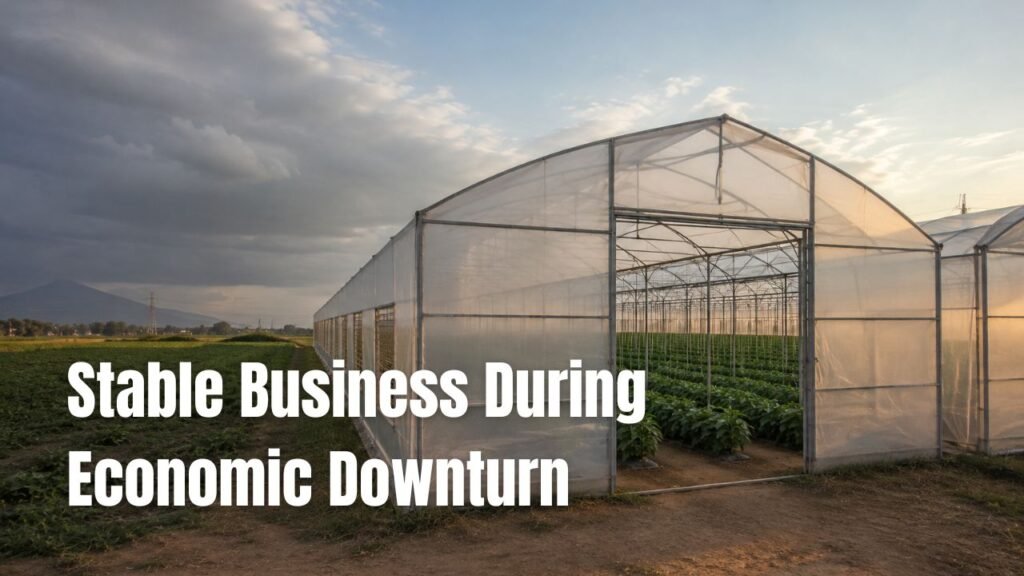
If demand resilience is the macro-level advantage agriculture has, protected cultivation adds a layer of operational resilience on top of it. A polyhouse reduces exposure to the weather-driven supply shocks that hit open-field farming hardest — more predictable yield, less vulnerability to an unseasonal hailstorm or an extended dry spell wiping out a season’s income. That combination — inelastic demand at the macro level, plus more controlled, predictable production at the farm level — is a genuinely different risk profile than most small businesses can offer, including the kind of price and demand pressure we discussed in our retail business comparison.
The Government Layer Adds Another Buffer
On top of the underlying demand stability, agriculture is also one of the few sectors where government subsidy support directly reduces your capital exposure — something most small business categories simply don’t have access to at a comparable scale. During periods of economic stress, agriculture also tends to receive continued policy attention given its role in food security and rural income, which is not something typically extended to, say, retail or consumer discretionary sectors during a downturn.
Our Honest Bottom Line
Agriculture, and protected cultivation specifically, offers a genuinely more stable demand foundation than most small businesses — this isn’t marketing spin, it’s supported by real economic research on food demand inelasticity and current rural-demand data. But it’s not a shortcut around good business fundamentals. Weather risk, local price volatility, and execution quality still determine whether an individual farm succeeds. Think of the recession-resistance as a structural tailwind, not a guarantee — it improves your odds, but doesn’t replace the need for a well-planned, well-executed operation.
Frequently Asked Questions
Is agriculture really recession-proof?
Not entirely — no business is. It’s more accurate to say agriculture is recession-resistant on the demand side because food consumption doesn’t fall much during downturns, while still being exposed to weather, supply chain, and price-volatility risks that have nothing to do with the broader economic cycle.
Did agriculture actually perform better than other sectors during COVID-19?
Underlying food demand held up well globally despite the sharp economic shock, though Indian agriculture did face real supply-chain disruption during lockdowns — transport blockades, labour shortages, and closed mandis. Demand resilience and operational disruption are two separate things, and both were visible during that period.
Does protected cultivation reduce recession risk more than open-field farming?
It doesn’t change the demand-side advantage, which applies to agriculture broadly, but it does reduce weather-driven supply risk specifically, giving you more predictable production alongside that stable underlying demand.
Should recession-resistance alone be my reason to start a polyhouse business?
It’s a strong supporting reason, but not a sufficient one by itself. Crop choice, market access, water quality, and execution still determine whether a specific farm actually succeeds — the macro advantage improves your odds, it doesn’t guarantee your outcome.
This article references published economic research on food demand elasticity and general market patterns as of 2026. It is intended as general business context, not investment advice. Please evaluate your specific situation before making a decision.
Want a business with structurally stable demand behind it?
AgroDome can help you plan a protected cultivation project that combines that demand resilience with predictable, well-managed production.
Get a Free Consultation