
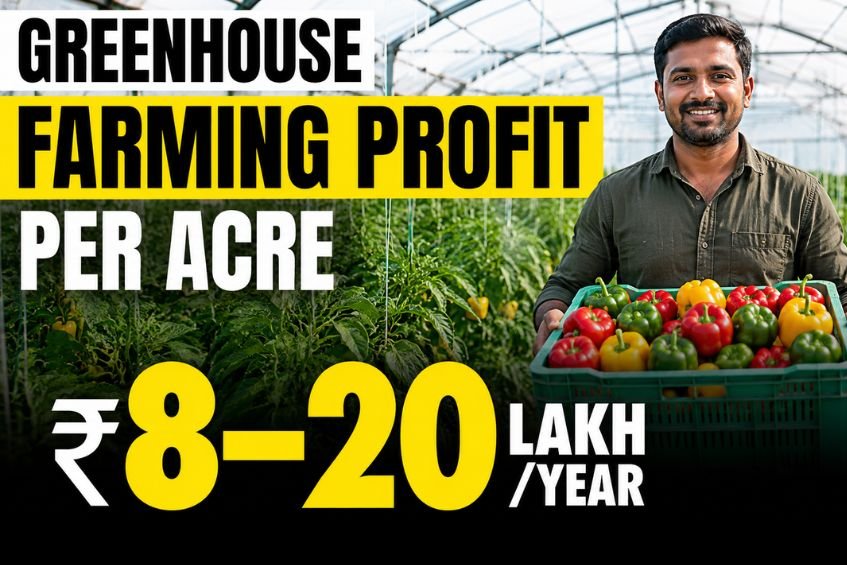
Every farmer who calls us asks some version of “what will I actually make per acre?” And every farmer has already read three different blog posts with three wildly different answers — ₹8 lakh, ₹20 lakh, sometimes numbers that sound closer to a lottery win than a farming return. The truth is all of them can be correct, just for very different setups, crops, and levels of execution. Let’s walk through what actually drives that number so you can figure out where your own project realistically lands.
Start With What You’re Actually Investing
Profit only means something in relation to what you put in. For a standard 1-acre naturally ventilated polyhouse (NVPH) in India, turnkey construction — structure, poly film, drip irrigation, civil work, and labour — typically runs ₹30–38 lakh, excluding land cost. Add a Fan & Pad cooling system for a hotter climate or a more demanding crop, and that figure can climb to ₹75–85 lakh. This is before subsidy, and before your first season of working capital for seeds, fertiliser, and labour.
Structure + irrigation + civil work: ₹30–38 lakh
With MIDH/NHM subsidy (~50% of cost norm): effective out-of-pocket often closer to ₹18–22 lakh
First-season working capital (seedlings, fertiliser, labour): ₹2–4 lakh, crop dependent
GST note: greenhouse construction services attract 18% GST — a cost many first-time farmers forget to budget for
Profit Per Acre, Crop by Crop
This is where the wide range of headline numbers actually comes from — different crops, different risk levels, different skill requirements. Here’s a realistic spread based on well-managed operations, not best-case scenarios:
| Crop | Typical net profit/acre/year | Risk/complexity level |
|---|---|---|
| Coloured capsicum | ₹8–14 lakh | Low — the standard entry point |
| Cucumber | ₹10–16 lakh | Moderate — fast cash but price-volatile |
| Tomato (indeterminate hybrids) | ₹15–20 lakh | Moderate — needs taller structure, more technical |
| Dutch roses / cut flowers | ₹12–18 lakh | High — highest revenue potential, but needs a guaranteed buyer and heavy technical input |
| Leafy greens (spinach, methi, etc.) | Generally not recommended for a full polyhouse | Low value per kg doesn’t justify high-cost structure — better suited to shade net houses |
Notice the pattern: the crops offering the highest headline numbers — roses, exotic flowers — also demand the most technical skill and the most reliable buyer relationships. A beginner chasing the biggest number on paper without that infrastructure in place often ends up worse off than someone who picked the “boring” but dependable capsicum crop.
Why Two Farmers Growing the Same Crop Get Different Profits
The same crop, the same acre, the same structure — and yet one farmer nets ₹14 lakh while another barely clears ₹6 lakh. This isn’t luck. It usually comes down to three things:
Market access. A farmer selling directly to hotels, exporters, or a stable trader relationship consistently earns more than one relying purely on the local mandi, where prices can swing sharply based on that day’s supply.
Climate control discipline. Skipping proper ventilation, shade screens, or fogger maintenance during peak heat doesn’t just reduce yield slightly — it can trigger flower drop and quality loss that shows up directly in your bottom line.
Overhead per kilogram. Very small units (under 1 acre) often struggle here — fixed costs like a supervisor’s salary, security, and transport get spread across less produce, making it harder to compete on price with larger, more efficient operations.
How Long Until You Actually Break Even
With the 50% government subsidy applied, most well-run polyhouse projects recover their investment in roughly 2 to 3 years. Without the subsidy, that stretches to 4 to 5 years. Both estimates assume a high-value crop like coloured capsicum, sold at reasonable average market prices — not the exceptional spikes that occasionally show up in headline case studies.
A Word on the “₹40 Lakh Profit” Posts You Might Come Across
If you see a claim that dramatically exceeds the ranges above, dig into what’s behind it before you plan your budget around it. It’s usually one of a few things: a larger multi-acre operation being expressed as a per-acre figure, a single exceptional season with unusually high prices, or a high-value niche crop like orchids that carries proportionally higher risk and complexity than the article mentions. None of that makes the number false — it just means it’s not the number a first-time, 1-acre farmer should expect in year one.
Frequently Asked Questions
What’s a realistic profit expectation for a first-time, 1-acre polyhouse farmer?
For a first attempt with a dependable crop like coloured capsicum, ₹8–12 lakh net profit per year is a realistic, well-supported range once the crop is established, assuming reasonable market access and proper climate management.
Does a bigger polyhouse mean proportionally bigger profit?
Not always in a simple straight line — larger operations often have better cost efficiency per kilogram, but they also demand more management capacity, labour coordination, and market volume. Scaling up amplifies both good and poor execution.
Is greenhouse farming profit guaranteed compared to open-field farming?
No form of farming carries a guarantee, but a polyhouse does significantly reduce weather-related risk and generally supports higher, more consistent yields than open-field cultivation of the same crop. Market price risk still applies either way.
Should I pick the crop with the highest profit-per-acre figure?
Not necessarily. Match the crop to your experience level, budget for market-building, and risk tolerance — a lower-headline crop you can execute well often outperforms a higher-headline crop you’re not yet equipped to manage.
Figures in this article are indicative estimates for 2026, drawn from industry data and field experience across polyhouse projects in India. Actual profit depends heavily on location, crop, market access, and farm management. Please consult our team for a project-specific projection before making investment decisions.
Want a realistic profit projection for your own land and crop choice?
AgroDome can walk you through a project-specific cost and return estimate — no inflated numbers, just what your setup can actually deliver.
Get a Free Consultation