
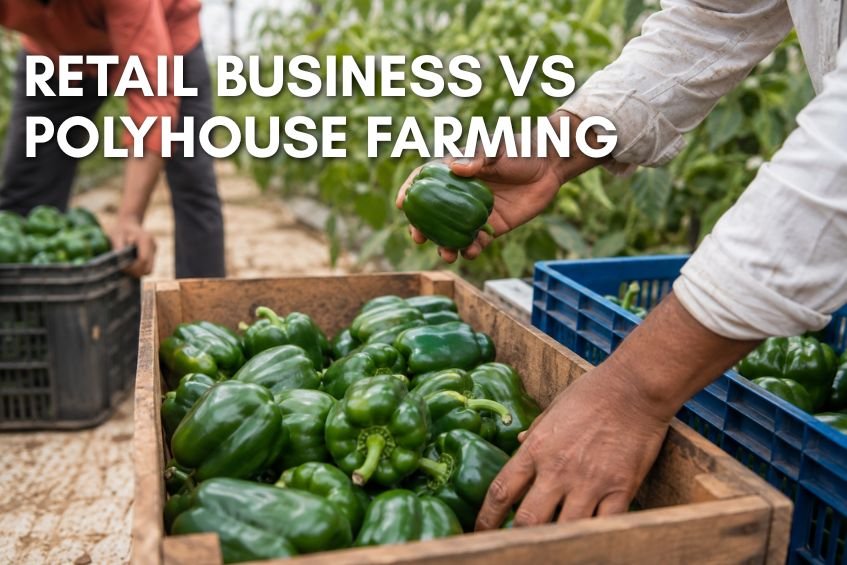
Two very different ways to put ₹20-30 lakh to work. Here’s an honest, numbers-based comparison — not a pitch for either side.
If you’ve got capital to deploy and you’re weighing a retail shop against a polyhouse project, you’re comparing two businesses that couldn’t be more different in how they make money — and that’s exactly why the comparison is worth doing properly. One gives you faster cash flow with thinner margins. The other asks for more patience but offers a fundamentally different cost structure. Let’s put real numbers next to each other.
Starting Investment: Different Entry Points
A small retail shop — grocery, clothing, electronics — typically needs anywhere from ₹2 lakh to ₹10 lakh to get started, depending on size and stock, with some formats like a basic kirana store possible for even less. A 1-acre polyhouse, by comparison, runs ₹30-38 lakh for a standard naturally ventilated structure before subsidy, dropping to roughly ₹18-22 lakh out-of-pocket once MIDH/NHM subsidy is applied.
On pure entry cost, retail wins easily — it’s simply more accessible to someone with limited starting capital. But entry cost alone doesn’t tell you much about long-term returns, which is really the question worth asking.

Profit Margins: A Genuinely Different Math
This is where the comparison gets interesting. Most Indian retail shops operate on net profit margins between 5% and 15% after rent, staff, and overheads — grocery and FMCG stores often sit even lower, in the 12-20% gross margin range before those costs bite in. Specialty retail like boutiques or electronics can push higher, but competition and discounting typically erode that over time.
A well-run capsicum or cucumber polyhouse, by contrast, routinely nets profit margins that would be considered exceptional in retail — largely because agricultural produce, particularly high-value protected-cultivation crops, commands a different cost structure. You’re not paying ongoing shop rent in a commercial area, you’re not competing purely on price against five other shops on the same street, and government subsidy support directly reduces your fixed capital cost in a way retail businesses don’t benefit from.
| Factor | Retail Shop | Polyhouse Farming (1 acre) |
|---|---|---|
| Starting investment | ₹2-10 lakh | ₹18-38 lakh (before/after subsidy) |
| Typical net margin | 5-20% depending on category | Significantly higher on revenue, crop dependent |
| Recurring fixed cost | Shop rent, staff salaries, ongoing | Labour, input costs — no monthly rent burden |
| Government support | Limited to general MSME schemes | Direct capital subsidy (MIDH/NHM), interest subvention |
| Time to meaningful cash flow | Immediate, from day one | First harvest in 2-4 months depending on crop |
| Tax treatment | Fully taxable business income | Agricultural income exempt under Section 10(1) |
The Competition Problem Retail Has That Farming Doesn’t
Here’s something worth sitting with. A retail shop’s biggest ongoing threat is usually the shop next door, or increasingly, e-commerce and quick-commerce platforms undercutting on price and convenience. Margins in categories like electronics have been squeezed to 5-10% precisely because of this pressure, and it only intensifies as more players enter.
A polyhouse farmer selling fresh, high-quality capsicum or cucumber faces a different kind of competition — mostly other growers, not a fundamentally different, cheaper delivery model threatening to make the business obsolete. Food demand is also inherently more stable than most retail categories, which don’t face the same existential pressure from changing consumer habits that many shop formats now do.
What Retail Genuinely Does Better
To be fair to retail, it has real advantages that shouldn’t be glossed over. Cash flow starts immediately — you sell something, you get paid, often the same day. There’s no multi-month wait for a first harvest, no dependency on weather or water quality, and lower barriers to entry mean you can start small and scale gradually without needing a large upfront loan. If you need income now, not in a few months, retail is the more forgiving starting point.
So Which One Actually Wins on Long-Term Returns?
For pure long-term return on capital invested, a well-run polyhouse operation tends to outperform a typical small retail shop, once you account for the subsidy-reduced entry cost, the tax-exempt income treatment, and margins that are structurally higher than most retail categories can sustain. But “tends to” is doing real work in that sentence — polyhouse returns depend heavily on crop choice, water quality, and market access, and a poorly planned farm can underperform a well-run shop just as easily as the reverse.
The honest answer is that these aren’t really substitutes for the same kind of person. Retail suits someone who needs faster cash flow and lower entry risk. Polyhouse farming suits someone who can handle a few months of patience, has (or can arrange) proper financing — bank financing works quite differently here than a typical MSME retail loan — and wants a business model with structurally better long-term margins and real government subsidy support behind it.
Frequently Asked Questions
Can I run both a retail business and a polyhouse at the same time?
Yes, and many of our clients do exactly this — running a polyhouse as a side investment alongside an existing retail or other business is a common and often sensible way to diversify income without walking away from a proven revenue source.
Is polyhouse farming riskier than retail?
The risks are just different in nature. Retail carries competitive and demand-shift risk (a new shop opening nearby, changing shopping habits); polyhouse farming carries crop, climate, and market-price risk. Neither is inherently “safer” in an absolute sense.
Which requires less day-to-day involvement?
A retail shop generally needs consistent daily presence or staffing to operate at all. A polyhouse can be run with a trusted on-ground manager if the owner isn’t physically present every day, though outcomes are usually better with regular owner involvement either way.
Does the tax exemption alone make polyhouse farming the better choice?
It’s a genuine advantage, but not a decisive one by itself — the underlying business fundamentals (margins, market access, execution) matter more than the tax treatment. Treat tax benefit as a meaningful bonus on a sound decision, not the deciding factor.
Figures in this article are general industry benchmarks for 2026 and will vary by location, category, scale, and execution. This is not financial advice — please evaluate your specific situation, ideally with professional guidance, before making an investment decision.
Weighing your options for where to invest?
AgroDome can walk you through realistic numbers for a polyhouse project matched to your budget, so you can compare it honestly against any other option on the table.
Get a Free Consultation