
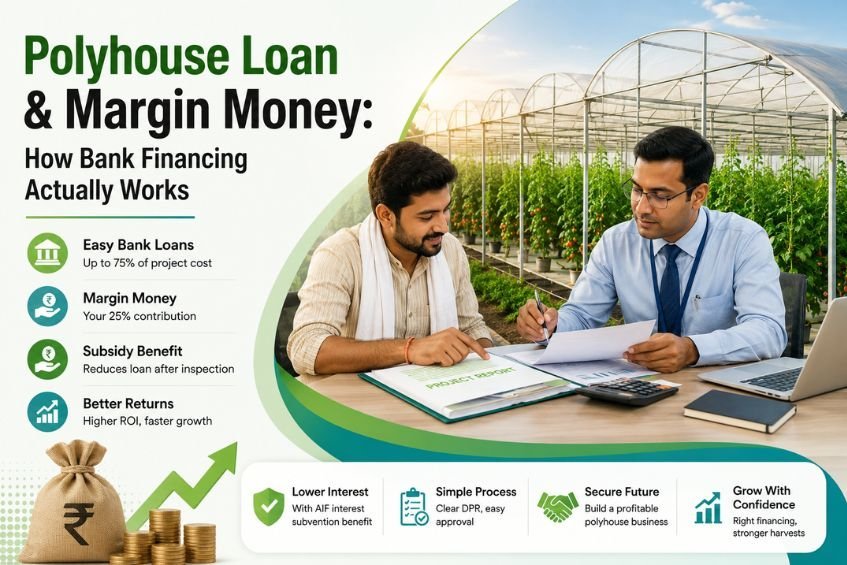
Nobody explains “margin money” properly until you’re already sitting across from a bank manager. Let’s fix that before you get there.
Every polyhouse subsidy conversation eventually leads to the same wall: “the subsidy is credit-linked.” Fine — but what does that actually mean for your pocket? How much does the bank pay, how much do you pay, and what exactly is a bank manager looking for when you walk in with your project file? This is the part almost nobody explains clearly, so let’s go through it the way we’d sit down and explain it to a client before their bank appointment.
What “Margin Money” Actually Means
Margin money is simply the portion of the total project cost that you bring in yourself — the bank won’t fund 100% of any project, polyhouse included. For most polyhouse loans, the standard split is the bank financing around 75% of the project cost, with you contributing the remaining 25% as margin money. That 25% isn’t optional and it isn’t negotiable at most nationalised banks — it’s their way of making sure you have real skin in the game.
Project cost (per MIDH cost norm): ₹40 lakh
Bank loan (75%): ₹30 lakh
Your margin money (25%): ₹10 lakh
Subsidy (say 50% of cost norm, credited later): ₹20 lakh — this reduces your outstanding loan after inspection, it doesn’t replace your margin money upfront
That last point trips a lot of farmers up. The subsidy comes after construction and inspection, and it reduces your loan balance — it does not cover your margin money. You still need that 25% ready in cash or arranged some other way before construction begins.
The Three Numbers Your Bank Manager Actually Cares About
A bank manager isn’t going to read your entire project report cover to cover. In practice, they’re scanning your Detailed Project Report for three specific numbers. Get these right and your file moves faster; get them wrong or missing and you’ll be sent back to redo the DPR.
| Metric | What it tells the bank | Ideal range |
|---|---|---|
| DSCR (Debt Service Coverage Ratio) | Whether your expected profit comfortably covers your EMI | Above 1.5 |
| IRR (Internal Rate of Return) | How good a return the project generates on the money invested | Above 20% |
| Payback period | How fast the bank’s loan effectively gets recovered through your project’s returns | 3 to 5 years |
If your DPR doesn’t clearly highlight these three figures, don’t expect the bank manager to calculate them for you. A well-prepared DPR does the manager’s job for them — that’s what gets applications approved faster.
Questions You Should Actually Prepare For
Beyond the numbers, bank managers ask a handful of predictable questions in almost every polyhouse loan interview. Walking in with clear answers ready makes a real difference.
“Who will buy your harvest?”
This is the question that catches most applicants off guard. Saying “I’ll sell at the local mandi” is a weak answer, since mandi prices swing wildly. A stronger answer names a specific buyer, trader relationship, or market channel you’ve already lined up.
“Why is your project cost higher than the NABARD guideline?”
NABARD/MIDH unit costs are revised infrequently and often lag behind current steel and cement prices. The right response is to point to your current vendor quotations and explain that building at the outdated norm would compromise structural quality.
“What if the crop fails or prices crash?”
Banks want to know you have a financial cushion beyond the polyhouse income itself — a spouse’s salary, income from other farming, or savings that can cover EMIs for several months if things go wrong.
Where to Actually Apply
Several nationalised and private banks run dedicated agriculture term loan products that cover polyhouse financing — State Bank of India offers schemes tailored for protected cultivation, Bank of Baroda runs its own Kisan-focused lending products, and Canara Bank has been particularly active in financing hi-tech agriculture projects. NABARD itself doesn’t lend to farmers directly — instead, it refinances the bank that lends to you, covering up to 90-95% of the eligible loan depending on the project. Mentioning “NABARD refinance” to your bank manager signals that you understand how the system works, which itself can smooth the conversation.
Don’t Miss the Interest Subvention Under AIF
One benefit that very few farmers actually claim is the Agriculture Infrastructure Fund (AIF) interest subvention. Under this scheme, the government pays 3% of your annual loan interest directly to the bank — so if your loan is sanctioned at 9%, your real cost of borrowing drops to roughly 6%. It applies to loans up to ₹2 crore for a period of 7 years, and eligible borrowers may also access a credit guarantee that reduces how much collateral you need to put up. The catch is that this doesn’t happen automatically — you need to register on the National Agriculture Infra Financing Facility portal and generate a Project ID, ideally at the same time as your bank loan application. Branch staff often don’t proactively bring this up, so it’s worth asking about directly.
Five Things That Get Loan Applications Rejected
A few recurring issues account for most rejections we’ve seen or heard about from clients:
2. Starting construction before the loan is sanctioned and the Letter of Intent is issued
3. A weak or vague marketing plan for the harvest, with no named buyer or channel
4. Land ownership documents that are incomplete, disputed, or on a short/unregistered lease
5. A DPR that doesn’t clearly show DSCR, IRR, and payback period, forcing the bank to ask for revisions
If any of these apply to your situation, it’s worth fixing them before you approach the bank rather than after a rejection — a rejected file often makes the next application harder, not easier.
Frequently Asked Questions
Can I use land as collateral instead of paying margin money in cash?
Margin money and collateral serve different purposes — margin money is your own financial stake in the project cost, while collateral secures the loan itself. Most banks require both, though credit guarantee schemes like CGTMSE can sometimes reduce the collateral requirement for eligible borrowers.
Does the subsidy reduce my margin money requirement?
No. The subsidy is credited to your loan account only after construction is inspected and approved. Your margin money still needs to be arranged and paid upfront, before that inspection ever happens.
Is 25% margin money fixed, or can it vary?
75:25 is the common split, but it can vary slightly by bank, borrower category, and project size — some categories of farmers may see more favourable terms. Always confirm the exact split with your specific bank before finalising your budget.
Which bank is best for a polyhouse loan?
There isn’t a single “best” bank — it depends on your branch’s familiarity with agricultural term loans and hi-tech farming schemes. Nationalised banks with an established agriculture lending desk, and cooperative banks active in your district, are usually a good starting point.
Loan terms, interest rates, margin requirements, and subvention schemes are set by individual banks, NABARD, and government departments, and are revised periodically. Figures in this article are indicative as of 2026 — please confirm current terms with your bank and District Horticulture Officer before applying.
Need help preparing a bank-ready DPR?
AgroDome can help you put together vendor quotations, cost estimates, and a project report structured the way banks actually want to see it.
Get a Free Consultation