
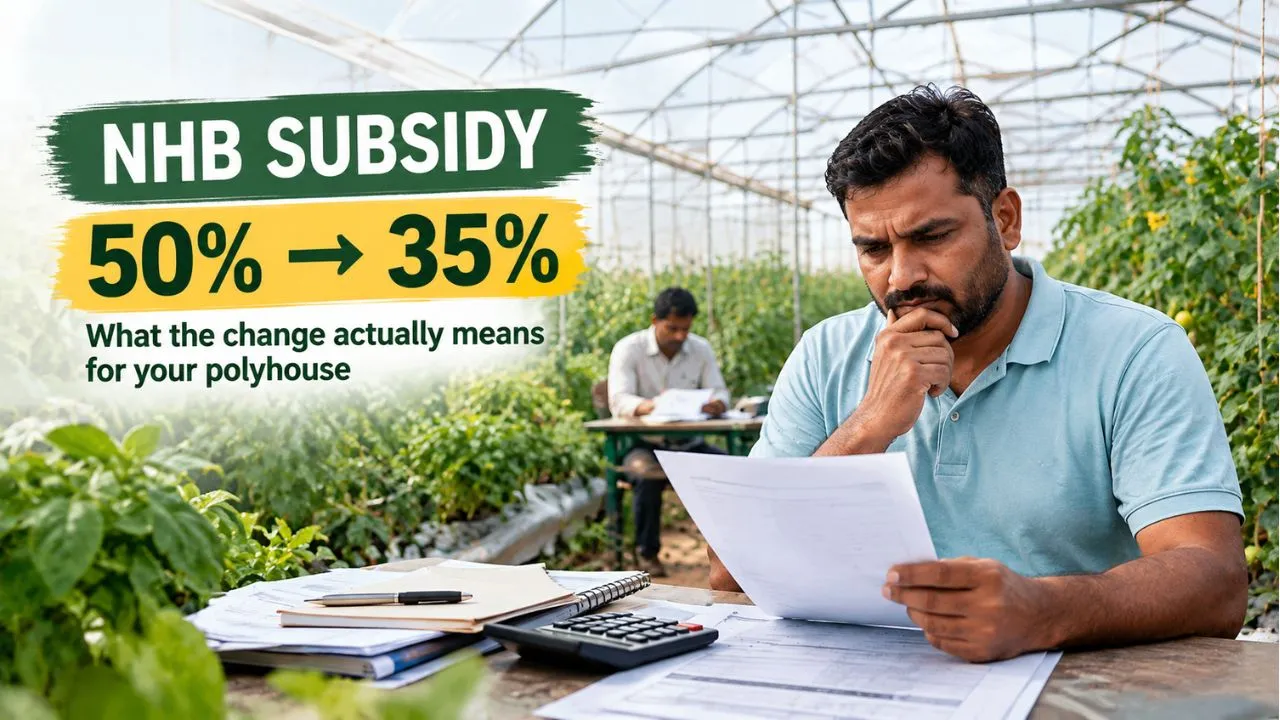
A real policy change, not a rumour — but the details matter far more than the headline number, and most people getting this secondhand are missing the important part.
If you’ve heard whispers that the government has cut polyhouse subsidy, you’ve heard something real — but probably not the full picture. The National Horticulture Board (NHB) revised its Commercial Horticulture and Cold Storage Scheme guidelines through a letter dated 21 August 2026, reducing financial assistance for protected cultivation projects in General Areas from 50% to 35%. This has already triggered visible pushback, including a farmer and greenhouse-manufacturer protest outside NHB’s regional office in Pune, and formal industry representations asking the government to reconsider. Here’s what’s actually changed, who it affects, and — just as importantly — who it doesn’t.
The Change, in Plain Terms
NHB’s Commercial Horticulture and Cold Storage Scheme previously offered 50% assistance on eligible protected cultivation project costs. Under the revised guidelines, that figure drops to 35% for General Areas. To make the real-money impact concrete: on an eligible project cost of ₹2 crore, assistance at 50% would have been ₹1 crore. At 35%, it’s roughly ₹70 lakh — a difference of about ₹30 lakh that now falls on the project’s financing instead of the subsidy.
Farmers and industry representatives protesting the change have also pointed out that the effective impact is compounded by existing cost pressures — 18% GST applies to construction materials, and farmers without GST registration can’t claim input tax credit on that, meaning the real gap between what a project costs and what assistance now covers is larger than the headline 15-percentage-point drop suggests.
The Part Almost Nobody Is Explaining Clearly: This Is an NHB Change, Not an NHM Change
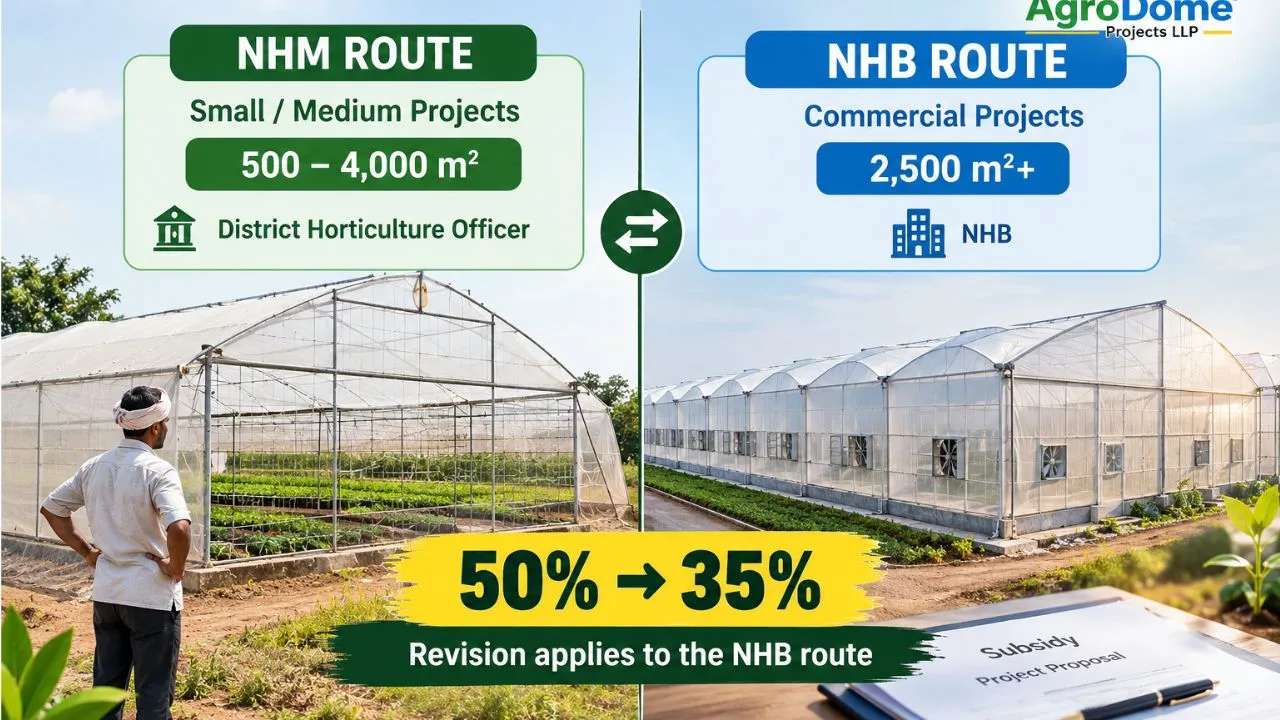
This is the single most important distinction in this whole story, and it’s exactly the detail getting lost as the news spreads secondhand. Protected cultivation subsidy in India runs through two separate central routes under the broader MIDH umbrella:
NHB route — for larger commercial projects, generally 2,500 sqm and above, capped at ₹1 crore in assistance, applied directly through NHB. This is the route the recent revision affects.
Based on current information, the 50%-to-35% cut applies specifically to the NHB route — the channel used by bigger commercial operations, not the NHM route most small and first-time farmers rely on. If you’re planning a standard 1-acre polyhouse through your DHO under NHM, this particular revision may not directly affect your application at all. If you’re planning a larger, 2,500+ sqm commercial project through NHB, this is very much relevant to your numbers.
We want to be careful here: scheme guidelines can and do get revised further, especially given the active pushback this change has already generated. Don’t treat this article as the final word — confirm your specific route’s current rate through your District Horticulture Officer or NHB directly before finalising your project budget.

Why This Change Happened (As Far As We Can Tell)
NHB hasn’t published a detailed public explanation alongside the revision, and industry representations have specifically asked the government to reconsider it in light of current project costs and financing conditions. Without an official rationale confirmed, it would be speculation to guess at the exact reasoning — whether it’s budget reallocation, an attempt to redirect commercial-scale investment elsewhere, or something else. What we can say is that this is clearly a live, contested decision, not a settled, uncontroversial policy update.
What This Means If You’re Planning a Project Right Now
If you’re a small or first-time farmer planning a 1-acre or smaller polyhouse through NHM: based on current information, your route appears unaffected, but confirm the current rate with your DHO before you finalise your budget — don’t assume based on this article alone, since guidelines can shift.
If you’re planning a larger commercial project through NHB: recalculate your financing at 35% assistance rather than 50% before committing. This changes your margin money requirement and loan sizing meaningfully — the kind of gap that needs to be planned for upfront, not discovered midway through construction.
Either way, it’s worth remembering that subsidy is only one part of the layered government support available to agriculture businesses — interest subvention under AIF, credit guarantees, and the tax-exempt treatment of agricultural income are separate mechanisms that this particular revision doesn’t touch.
Our Honest Take
A cut from 50% to 35% on the NHB route is a genuine setback for larger commercial protected cultivation projects, and pretending otherwise wouldn’t serve anyone. But it’s not the sweeping end of subsidy support for protected cultivation that some secondhand versions of this news are making it sound like — the route most small and first-time farmers actually use appears to still be running at the standard rate. If you’re currently planning a project, the right move isn’t panic or paralysis — it’s getting an accurate, current answer for your specific route and project size before you finalise anything.
Frequently Asked Questions
Does this subsidy cut affect small farmers applying through NHM/DHO?
Based on current information, this specific revision applies to the NHB route for larger commercial projects, not the NHM route most small and medium farmers use through their District Horticulture Officer. Confirm directly with your DHO, since this is a recent and actively contested change.
Is this subsidy cut final, or could it be reversed?
It’s currently being actively contested — farmer protests and formal industry representations are already pushing for reconsideration. Whether the government revises it further isn’t something we can predict, so it’s worth following for updates rather than treating it as permanently settled.
What if my project was already approved under the old 50% guidelines?
This is exactly the concern industry representatives have raised, asking for projects initiated under earlier guidelines to be protected from the financial impact of the revision. Check directly with NHB on transitional provisions for your specific application status.
Should I still go ahead with a protected cultivation project given this change?
That depends heavily on which route applies to your project size and your recalculated numbers at the current rate. It’s not a reason to abandon the idea outright, but it is a reason to get accurate, current figures before committing capital.
This article covers a recent and actively evolving policy change as of August 2026, based on publicly available reporting and industry representations. Scheme guidelines, rates, and eligibility can be revised further — please confirm current terms directly with NHB (nhb.gov.in) or your District Horticulture Officer before making any project or financing decisions.
Not sure how this affects your specific project?
AgroDome can help you check the current rate for your project size and route, and recalculate your financing accordingly — before you commit any capital.
Get a Free Consultation