
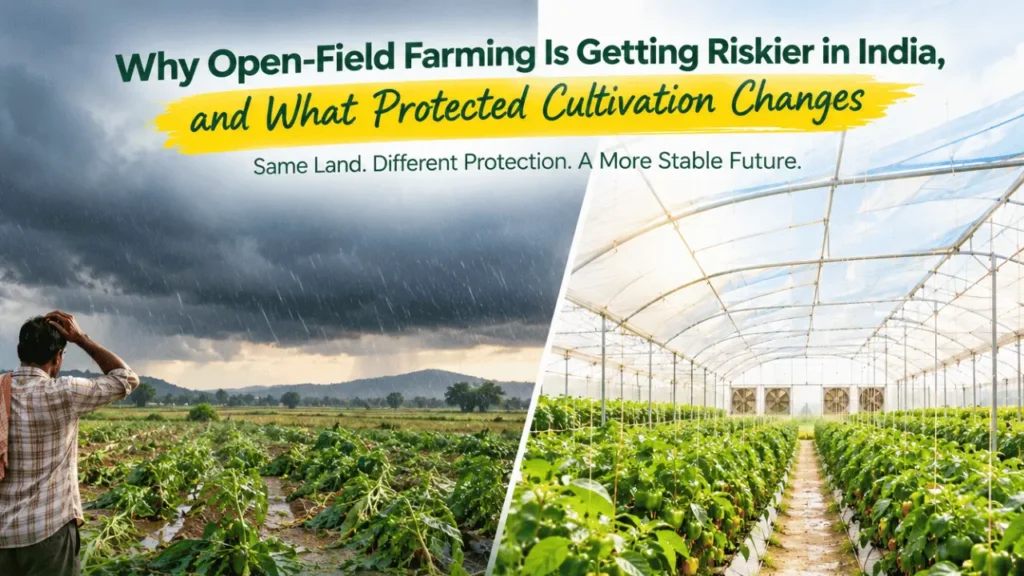
Why Open-Field Farming Is Getting Riskier in India, and What Protected Cultivation Changes
The weather farmers planned around for decades has stopped behaving. Here is what that means for income, and why more growers and investors are looking at controlled-environment farming.
Ask any farmer who has been at it for twenty years and you’ll hear a version of the same sentence: “The seasons aren’t what they used to be.” For a long time that was a feeling. Now it shows up in the data, in the mandi, and in the loan repayments of people who did everything right and still lost a crop. This post is the first in a series on climate-resilient farming and building an agriculture business around it. We’ll start with the problem itself, because understanding it honestly is what makes the solution make sense.
The Weather Pattern Has Shifted, and the Losses Show It
Analysis of 2026 crop-damage data points to a new high-risk window for Indian farmers: the weeks just before the monsoon. Unseasonal rain and hailstorms in March and early April 2026 were reported to have damaged more than six lakh hectares of crops, with losses appearing in nearly every region of the country rather than in a few usual hotspots. The timing is what hurts most. This kind of weather tends to strike when a crop is standing and close to harvest, which leaves almost no chance to replant or recover.
Heat is the other half of the story. Reports describe 2026 as one of the warmest years on record, with longer and more frequent heatwaves. Farmers in parts of Maharashtra reported temperatures above 42°C in a season that normally sits in the mid-30s, and the result was severe: very heavy mango losses and sharply lower cashew yields. Earlier heatwave years have been linked to wheat yield losses in the range of 15 to 25 per cent in the worst-hit areas. Even field work itself suffers, since extreme heat cuts the hours people can safely work outdoors.
Why Small and Mid-Size Farms Feel It Most
More than 60 per cent of India’s net sown area depends on rain rather than assured irrigation, and that land produces a large share of the country’s food. When rain arrives at the wrong time, or doesn’t arrive, there is no buffer. Larger operations can absorb a bad season. A farmer working a few acres usually can’t, especially without cold storage, refrigerated transport or crop insurance that pays out quickly.
Perishable crops make this worse. Vegetables such as tomato and onion are extremely sensitive to weather, and reports from recent seasons describe output falling by double digits in affected states, while prices swing wildly. Some farmers have even dumped produce because the sale price wouldn’t cover transport and sorting. When one bad season can wipe out the margin and leave debt behind, the question stops being “how do I earn more?” and becomes “how do I stop losing so much?”
What Actually Changes When You Grow Under Cover
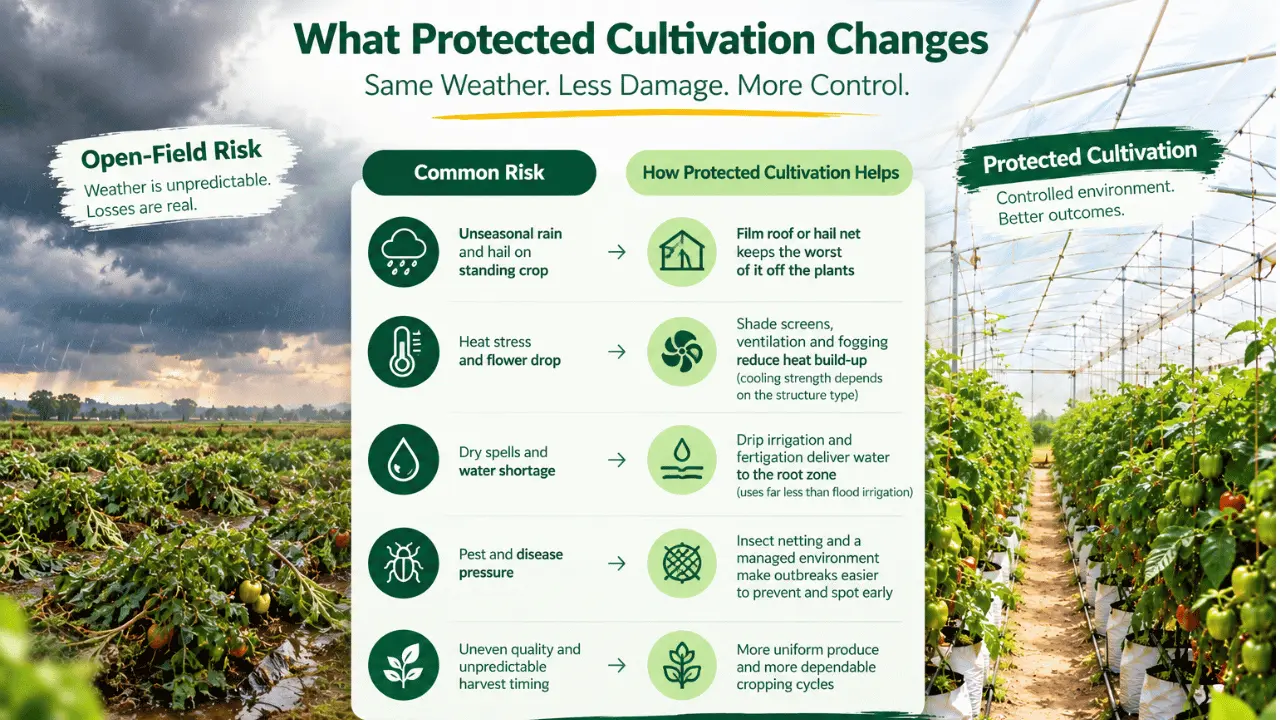
Protected cultivation doesn’t change the weather. It changes how much of the weather your crop has to deal with. A structure such as a polyhouse or shade net house puts a layer between the plant and the worst of the conditions, and lets the grower manage what’s left. Here is how that plays out against the main risks.
| Open-field risk | What protected cultivation does |
|---|---|
| Unseasonal rain and hail on standing crop | A film roof or hail net keeps the worst of it off the plants |
| Heat stress and flower drop | Shade screens, ventilation and fogging reduce heat build-up (cooling strength depends on the structure type) |
| Dry spells and water shortage | Drip irrigation and fertigation deliver water to the root zone and typically use far less than flood irrigation |
| Pest and disease pressure | Insect netting and a managed environment make outbreaks easier to prevent and spot early |
| Uneven quality and unpredictable harvest timing | More uniform produce and more dependable cropping cycles, which supports steadier buyer relationships |
For many growers the practical gain is not a dramatic jump in yield. It’s a narrower range of outcomes: fewer ruined seasons, more produce that meets the grade buyers want, and an income you can plan a loan repayment around.
What It Does Not Protect You From
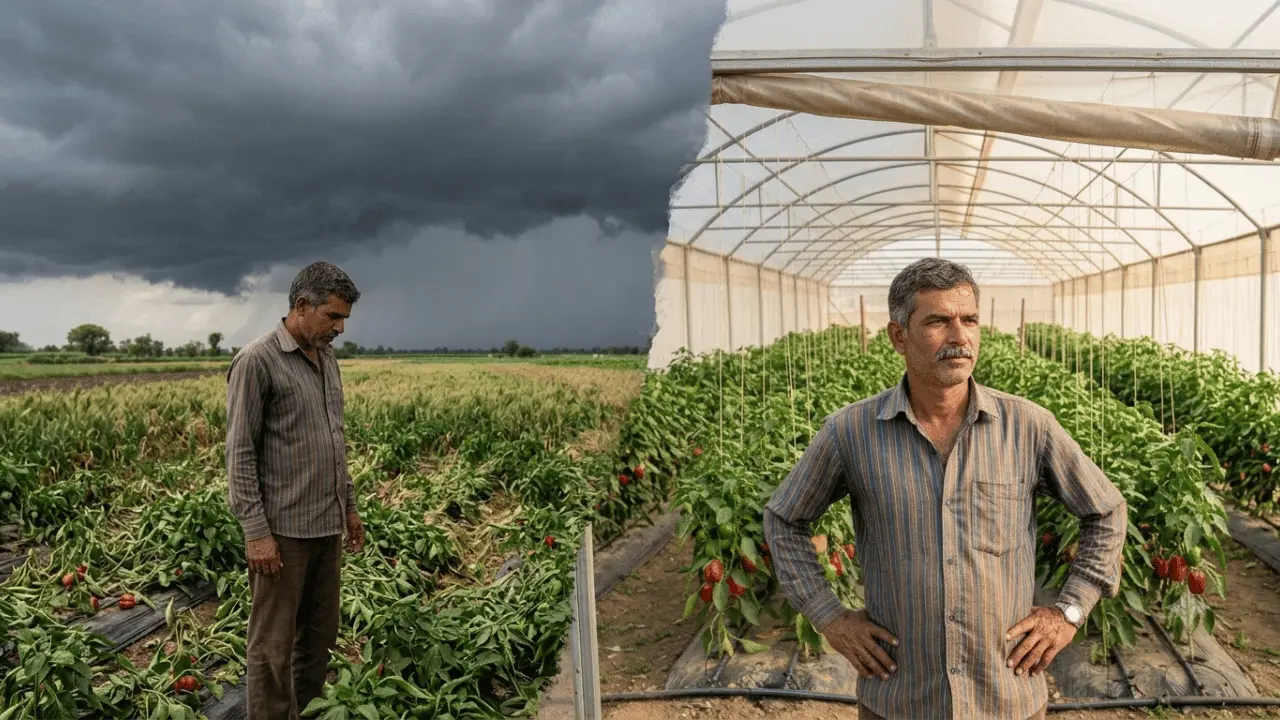
A fair version of this story has to include the limits, and there are several. A polyhouse is a built structure, so a severe storm or strong cyclonic wind can damage it if it wasn’t designed and anchored for local conditions. A basic naturally ventilated structure can also get very hot in peak summer, which is why cooling design matters. Systems that rely on fans or pumps depend on a steady power supply. And protected cultivation does nothing about market price swings: a glut of capsicum will still lower your selling price, however good your crop looks. It also needs more capital up front than open-field farming. We’ll cover these limits in detail in the next post in this series, because knowing them is what separates a well-planned project from a disappointed one.
What This Means for Farmers
If you farm a few acres and have watched a season disappear to hail or heat, the case for protected cultivation is mostly about stability. A smaller area under cover can earn more reliably than a larger open field exposed to every weather swing, and a crop you can plan around makes borrowing and repayment far less stressful. You don’t have to convert everything. Many growers start with a half-acre or one-acre structure, or a lower-cost shade net house for leafy crops and nurseries, and expand once they’ve seen it work on their own land.
What This Means for Investors
For someone looking at agriculture as an investment rather than a livelihood, the same logic applies in financial terms. Food demand is steady, and a protected cultivation project turns a weather-dependent activity into something closer to a managed production unit, with a physical asset behind it. That said, it is still farming. Returns depend on crop choice, water quality, the quality of the person running the farm, and whether a buyer is lined up before harvest. Before committing capital, an investor should ask a few plain questions:
Who will run the farm day to day, and what is their track record?
Has the water been tested, and does it suit the planned crop?
Is there a named buyer or sales channel, or just an assumption?
Does the budget include working capital for the first season, not just construction?
What happens to the project if prices fall for one full season?
The Funding Picture Right Now
Government subsidy support still exists for protected cultivation, but the terms are shifting. NHB has revised its assistance for larger commercial projects in general areas from 50 per cent to 35 per cent, while smaller projects through the NHM route are handled separately. Policy is still being debated, so confirm current rates for your route with your District Horticulture Officer before you build a budget around any number.
Where to Start
Start with three things before you look at any structure: get your water tested, decide which crop and buyer you’re building around, and work out your funding route. After that, a proper project management service can take you from site assessment through design, construction and handover, so the structure fits your climate and your crop rather than just your quotation.
2. What a polyhouse can and can’t protect against: heat, hail, heavy rain, wind and pests
3. Safe cropping in worst conditions: a season-by-season crop plan for Gujarat
4. Agriculture investment for non-farmers: how a protected cultivation project is structured and funded
5. Your first 12 months: starting a climate-resilient agriculture business step by step
Frequently Asked Questions
Is protected cultivation really safer than open-field farming?
It reduces exposure to rain, hail, pests and some heat stress, which usually makes production more predictable. It does not remove risk: structural damage in severe storms, power dependence, and market price swings still apply.
Can a small farmer with one or two acres afford this?
Many start with a half-acre to one-acre structure, or a lower-cost shade net house, and use subsidy and bank financing to reduce the upfront burden. Starting small and expanding after a season or two is a common and sensible path.
Will protected cultivation work in Gujarat’s heat?
Yes, with the right design. In hot regions, structure type, shade screens, ventilation and crop timing matter a great deal, and the choice should be matched to your crop and location instead of copied from a cooler region.
Is this a good option for someone who isn’t a farmer?
It can be, if the project has a capable manager, a tested water source, and a lined-up market. Investors should treat it as a business with real operational risk, take proper financial and legal advice, and never rely on headline profit figures alone.
Weather, crop-loss and policy information in this article reflects publicly reported analyses as of 2026 and is paraphrased for general guidance. Conditions and subsidy terms change and vary by region and scheme. Protected cultivation reduces some risks but does not eliminate them, and returns are not guaranteed. This is not financial advice; please get project-specific guidance and confirm current terms with the relevant authorities before investing.
Want to see what a climate-resilient project looks like for your land?
AgroDome can assess your site, water and crop plan and give you a realistic picture of cost, risk and return before you commit.
Get a Free Consultation