
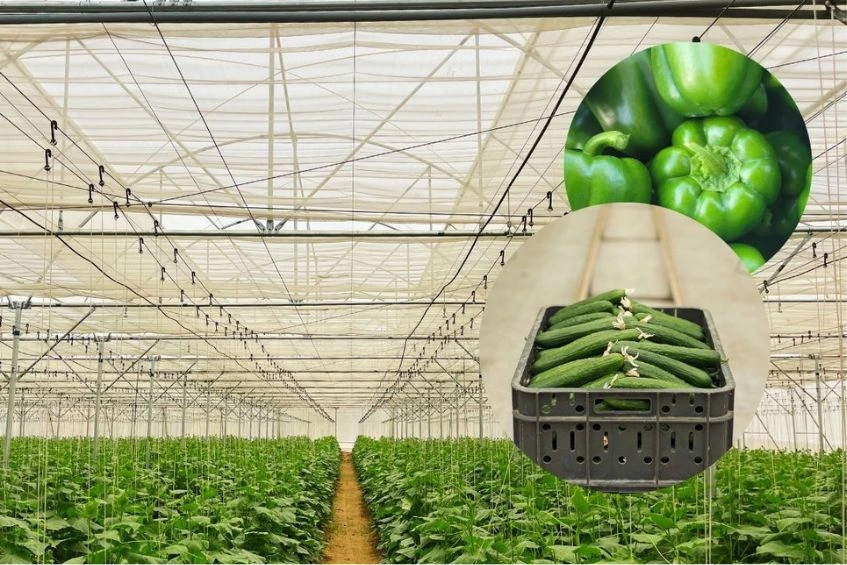
A straight-talking breakdown of cost, yield and real profit — for farmers in Gujarat deciding what to grow first.
Every second farmer who walks into our office in Gandhinagar asks some version of the same question: “Capsicum or cucumber — which one should I actually plant?” It’s a fair question, and honestly, most of the answers floating around online are either too rosy or too vague to be useful. So let’s do this properly, with real numbers, and without pretending either crop is a guaranteed jackpot.
Both crops do well under a Naturally Ventilated Polyhouse (NVPH) in Gujarat’s climate. But they behave very differently as businesses — one gives you a slow, steady income; the other gives you fast cash but keeps you working every single day. Let’s break both down.
Capsicum: The Slow-and-Steady Option
Coloured capsicum (red and yellow bell pepper) is usually the crop we recommend to first-time polyhouse farmers, and there’s a reason for that. It’s forgiving, the market for it is stable, and hotels, caterers and quick-commerce platforms need it year-round — so you’re rarely stuck without a buyer.
On a standard 1-acre (4,000 sq. m) NVPH, you’re typically looking at around 12,000 plants. The crop takes about 60–75 days to start fruiting, and the full cycle runs 8 to 10 months, with harvesting continuing steadily through that window.
Yield: roughly 30–45 tonnes per year (can go higher with excellent climate control)
Market price: ₹40–₹80/kg on average, with spikes up to ₹100–150/kg in off-season windows
Gross revenue: ₹15–25 lakh per year is a realistic range for a well-managed farm
Net profit: commonly falls between ₹8–15 lakh per year after input, labour and packaging costs
The catch with capsicum is patience. You’re waiting two to two-and-a-half months before your first harvest, and your capital is tied up longer. But once it starts producing, the picking schedule is manageable — every 4–5 days — so it doesn’t demand daily attention the way cucumber does.
Cucumber: The Fast Cash Crop
If capsicum is the slow build, cucumber is the sprint. It’s the crop most farmers use when they need income moving quickly — first harvest in just 35–40 days, and because it grows so fast, you can actually run two to three crop cycles a year from the same structure.
Yield: 100–150 tonnes per year is achievable across multiple cycles
Market price: highly seasonal — can range from ₹4–6/kg during a glut to ₹15–20/kg in a good window
Gross revenue: often in the ₹18–25 lakh range annually across cycles
Net profit: typically ₹10–16 lakh per year, but this swings more than capsicum’s does
The honest downside here is price volatility. Cucumber floods the market easily because everyone can grow it quickly, and when that happens, prices crash hard — sometimes to a level where you’re barely covering harvesting labour. The crop also needs picking every alternate day, which means daily labour cost eats a real chunk of your margin — often 20–25% of recurring costs.
Side-by-Side: Capsicum vs Cucumber
| Factor | Capsicum (Coloured) | Cucumber |
|---|---|---|
| First harvest | 60–75 days | 35–40 days |
| Crop cycles per year | 1 (8–10 month cycle) | 2–3 |
| Picking frequency | Every 4–5 days | Every alternate day |
| Price stability | Relatively stable | Volatile, prone to crashes |
| Labour demand | Moderate | High, near-daily |
| Best suited for | First-time growers wanting steady returns | Farmers who need faster cash flow and can manage daily labour |
What the Numbers Don’t Tell You
Here’s the part most guides skip: yield and price figures are only half the picture. We’ve seen farmers with a beautiful 40-tonne capsicum harvest end up disappointed because they hadn’t lined up a buyer before harvest started, and had to sell through a middleman at a fraction of the market rate. On the flip side, we’ve seen cucumber growers do very well simply because they had a standing arrangement with a local vegetable trader before the first seed went in the ground.
So the real advice we give clients isn’t “grow this crop” — it’s “know who’s buying your harvest before you plant it.” That single decision affects your actual take-home profit more than the crop choice itself.
A Practical Middle Path
If your budget allows it, splitting a larger plot between the two — say, capsicum on one portion and cucumber on another — is a strategy we often recommend. It smooths out your cash flow: cucumber brings in money early and often, while capsicum builds toward a steadier, larger payout later in the season. It also spreads your market risk across two different buyer bases instead of betting everything on one crop’s price cycle.
Frequently Asked Questions
Can I grow capsicum and cucumber together in the same polyhouse?
Yes — they share similar temperature and humidity needs, so mixing them in the same structure (in separate beds) works well. Just avoid mixing crops with very different needs, like flowers and vegetables, in one polyhouse.
Which crop is better for a first-time polyhouse farmer?
Most agronomists, including our team, lean toward capsicum for beginners. It’s more forgiving of small management mistakes and the price swings less violently than cucumber’s.
Do these profit figures include the polyhouse construction cost?
No — the numbers above cover crop-cycle operating costs and revenue only. Construction cost is a separate, one-time investment, and government subsidy under NHB/MIDH guidelines can bring that down significantly. We can walk you through both calculations together.
What water quality do these crops need?
Both prefer irrigation water with an EC below 1.0. If your water tests higher than that, budget for an RO unit — skipping this step is one of the most common causes of poor yield we see on-site.
Figures in this article are indicative, drawn from industry data and field experience across polyhouse projects in India. Actual yield, price and profit will vary based on location, variety, market access, and farm management. Please consult our team for a project-specific estimate before making investment decisions.
Not sure which crop fits your land and budget?
Talk to AgroDome’s team for a free, honest assessment based on your soil, water and local market access in Gujarat.
Get a Free Consultation