
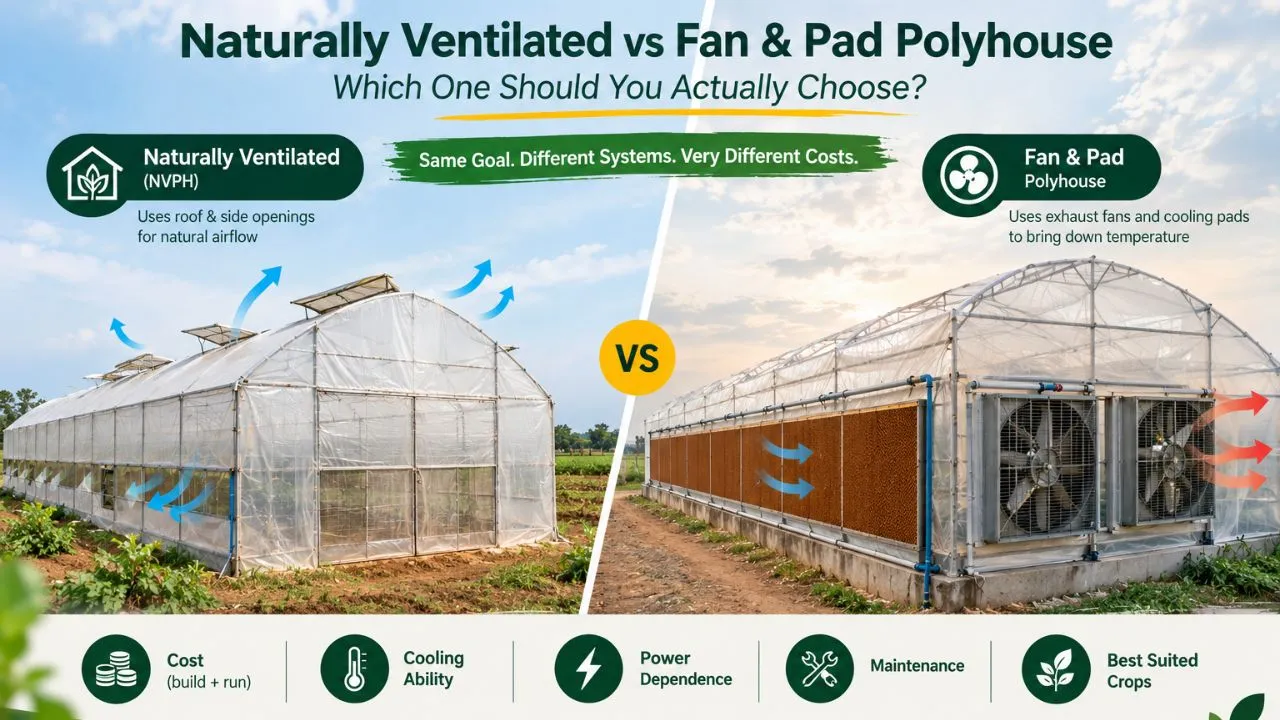
Naturally Ventilated vs Fan & Pad Polyhouse: Which One Should You Actually Choose?
One costs roughly twice as much as the other. Whether that extra money earns itself back depends on three things most buyers never ask about.
If you’ve started getting quotations for a polyhouse, you’ve probably noticed two very different price tags for what looks like the same thing from the outside. One is a naturally ventilated polyhouse (NVPH). The other is a fan and pad polyhouse. Both are covered in poly film, both grow vegetables, and yet one can cost close to double the other. So the real question isn’t which one is “better.” It’s which one fits your crop, your location and your budget. Let’s go through it the way we’d explain it across a table at our office.
How Each One Actually Cools Your Crop
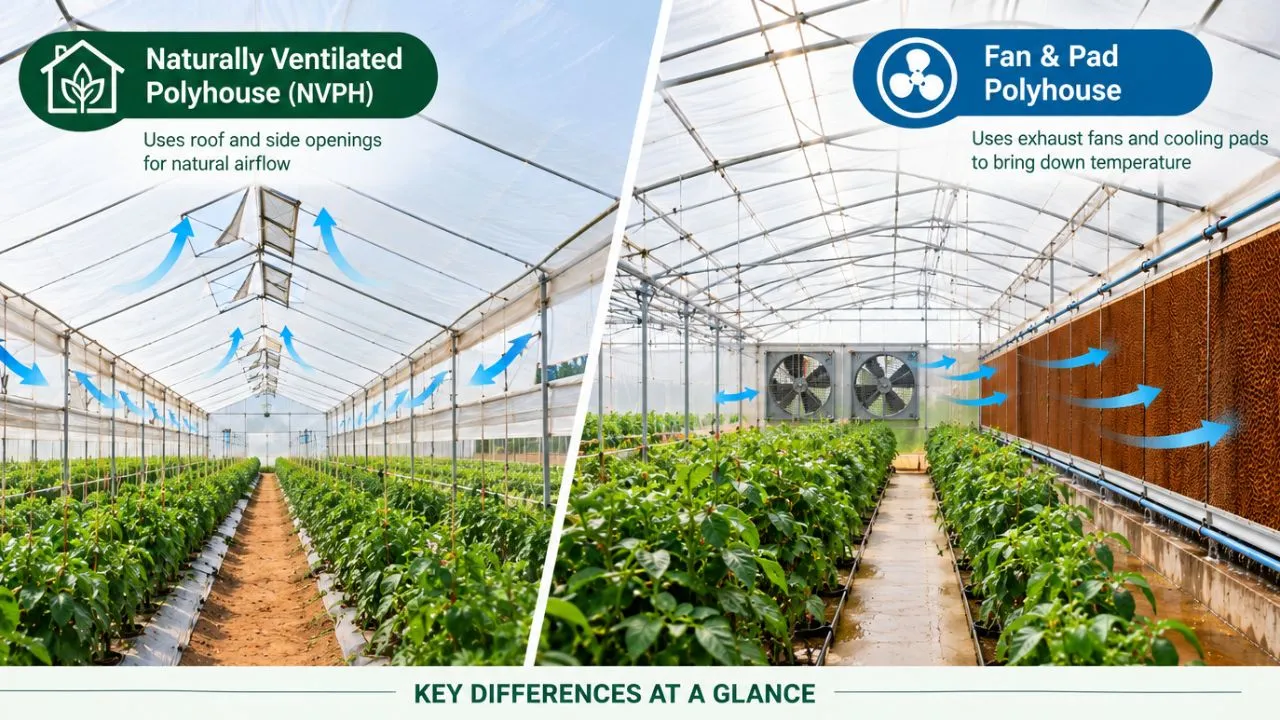
A naturally ventilated polyhouse relies on openings in the roof and side walls to let hot air rise out and cooler air flow in. There are no motors and no electricity bill for cooling. The limitation is simple physics: it can reduce the heat build-up inside, but it cannot bring the temperature below what it is outside.
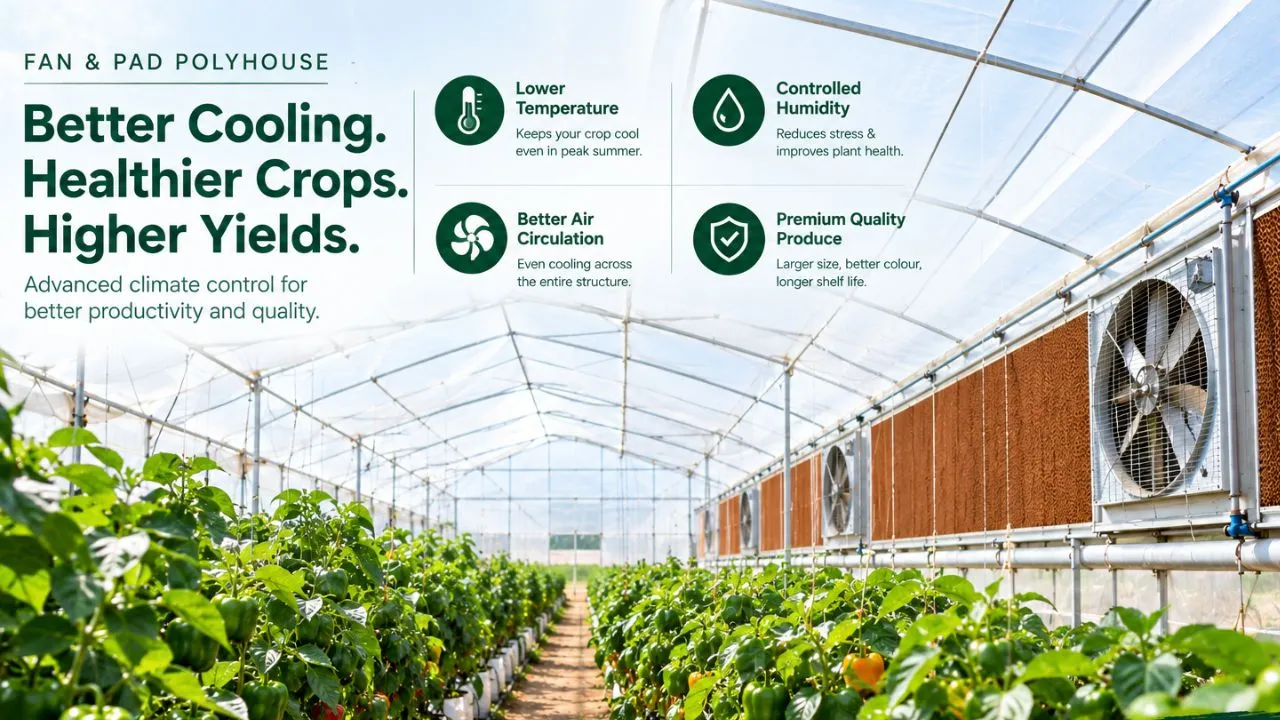
A fan and pad polyhouse works differently. Exhaust fans on one wall pull air through wet cooling pads on the opposite wall, and the evaporation of that water cools the incoming air. Done well, this can hold the inside temperature noticeably below the outside temperature, often by several degrees, which is something an NVPH simply can’t do on a hot afternoon.
The Side-by-Side Comparison
| Factor | Naturally Ventilated (NVPH) | Fan & Pad |
|---|---|---|
| Turnkey cost per acre (before subsidy) | Roughly ₹32–38 lakh | Roughly ₹60–85 lakh |
| Cooling ability | Cannot go below outside temperature | Can run well below outside temperature in dry heat |
| Monthly running cost | Very low (a few thousand rupees at most) | High, often in the tens of thousands, mostly electricity |
| Dependence on power supply | None for cooling | High: a long power cut in summer is a real risk |
| Maintenance | Simple: film, vents, structure | More complex: fans, pads, pumps, controls, water quality |
| Crops it suits best | Capsicum, cucumber, tomato, gerbera | Heat-sensitive or premium crops: strawberry, lettuce and hydroponics, nursery saplings |
These are indicative ranges drawn from industry sources, and your actual quotation will depend on specification, size and site. The pattern, though, is consistent: fan and pad costs roughly twice as much to build and noticeably more to run every single month.
Where Gujarat Complicates the Decision
Gujarat is one of the regions where this comparison genuinely isn’t obvious, and it’s worth being specific about why. In hot, dry parts of the state, such as north and central Gujarat, evaporative cooling works well because dry air absorbs moisture easily. That’s the argument for fan and pad here, and it’s a real one.
But two things push the other way. First, in humid conditions, including monsoon months and coastal belts, evaporative cooling loses much of its effect, so you may be paying for a system that underdelivers for part of the year. Second, the pads depend on a steady supply of reasonably clean water. Hard or saline groundwater, which is common in parts of Gujarat, can leave mineral deposits on the pads and shorten their life. If you haven’t tested your water yet, do that before you even compare quotations.
The Middle Path Most Gujarat Growers Overlook
The choice isn’t always NVPH versus fan and pad. For hardy crops like coloured capsicum and cucumber, a well-designed NVPH with a thermal or shade screen and foggers can handle most of Gujarat’s summer without the cost of a fully mechanical system. You give up some cooling power in the very hottest weeks, and many growers manage that by planning shorter crop cycles around the peak rather than fighting through it.
This is the setup we’d usually suggest to a first-time grower with a standard crop. It keeps your capital cost and your monthly bills low while you learn the business, and you can still add cooling measures later if the numbers justify it.
When Fan & Pad Genuinely Earns Its Price
We’re not arguing against fan and pad. It makes real sense when you’re growing a crop that simply won’t tolerate Gujarat’s summer heat in an NVPH, such as strawberries or premium leafy greens, when you have a secured buyer paying a price that supports the higher cost, and when your power supply is reliable enough to depend on. If all three are true, the extra investment can pay off. If even one is shaky, it’s worth pausing.
Don’t Forget How Subsidy Treats Each Type
Both structure types can be eligible for subsidy support, but the subsidy is calculated on a government cost norm for each structure type, not on your actual invoice. A larger fan and pad project also tends to push you toward bigger-project routes, where the rules and rates differ from the smaller-farmer route. Subsidy rates have also been revised recently for some commercial projects, so confirm the current terms for your route with your District Horticulture Officer before you build your budget around any figure.
A Simple Way to Decide
Ask yourself four questions. Is my crop hardy, like capsicum or cucumber, or heat-sensitive, like strawberry? Do I have a buyer who will pay a premium that justifies double the capital? Is my power supply dependable? Has my water been tested? If the answers point toward a hardy crop, a tighter budget, or uncertain power, start with an NVPH. If they point toward a premium crop, a committed buyer and reliable power, fan and pad deserves a serious look. Either way, a proper project management service that looks at your site, water and crop together will save you from choosing on price alone.
Frequently Asked Questions
Is a fan and pad polyhouse always better than an NVPH?
No. It cools better in hot, dry conditions, but it costs more to build, more to run, and depends on power and water quality. For hardy crops like capsicum and cucumber, an NVPH is often the more sensible financial choice.
Can I start with an NVPH and add cooling later?
You can add measures like shade screens and foggers to an NVPH later, and many growers do. Converting to a full fan and pad system is a bigger job, so it’s better to plan for it from the start if you think you’ll need it.
What happens in a fan and pad polyhouse if the power goes out?
In a sealed structure, a long outage during summer can be serious, because the cooling stops and heat builds up quickly. Growers using fan and pad usually plan a generator or other backup power.
Does water quality matter for fan and pad systems?
Yes. Hard or saline water can leave deposits on the cooling pads and reduce their life and performance, so get your water tested before choosing this system.
Costs and performance figures in this article are indicative ranges for 2026 drawn from general industry information and will vary by vendor, specification, region and site conditions. Subsidy terms are revised periodically. Please get a project-specific quotation and confirm current subsidy terms with your District Horticulture Officer before making an investment decision.
Not sure which structure suits your crop and budget?
AgroDome can look at your site, water source and crop plan and recommend the structure that makes financial sense, not just the most expensive one.
Get a Free Consultation