
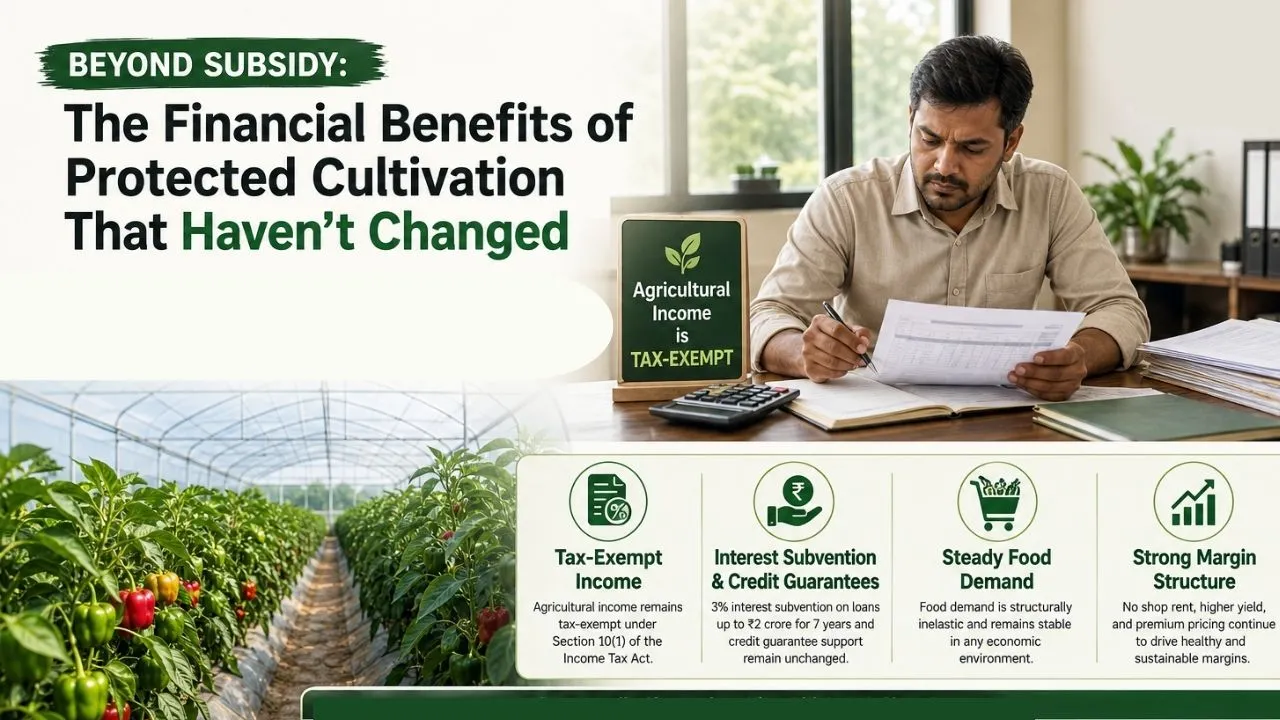
Beyond Subsidy: The Financial Benefits of Protected Cultivation That Haven’t Changed
Subsidy rates move — we’ve written two posts about exactly that recently. But subsidy was never the whole reason this business makes financial sense. Here’s everything else, still fully intact.
After covering the recent NHB subsidy revision in detail, we noticed something in the conversations that followed — a lot of people started talking as if subsidy was the entire financial case for protected cultivation, and a cut to one part of it meant the whole opportunity was shakier than it actually is. That’s not accurate. Subsidy is one input into the decision, not the foundation it’s built on. Here’s everything else that makes this a sound business, none of which has moved.
Agricultural Income Is Still Tax-Exempt
This is arguably the most underrated financial advantage in this entire industry, and it has absolutely nothing to do with NHB or NHM. Under Section 10(1) of the Income Tax Act, agricultural income stays tax-exempt regardless of what happens to construction subsidy rates. Compare this to a retail business or a trading operation, where every rupee of profit is taxed at your applicable slab rate — this structural difference in how your income is treated doesn’t shrink just because the government adjusted a construction cost-sharing percentage.
Run the numbers on a ₹15 lakh annual profit, and the tax saved compared to an equivalent amount of fully-taxable business income is substantial, year after year, for as long as you’re farming — a recurring benefit that compounds over the life of the business in a way a one-time construction subsidy simply doesn’t.

Interest Subvention and Credit Guarantees Are Untouched
The NHB revision touched construction cost-sharing specifically — it didn’t touch the interest subvention and credit guarantees available through the Agriculture Infrastructure Fund. The government still covers 3% of your annual loan interest on eligible projects up to ₹2 crore over a 7-year period, and credit guarantee mechanisms still reduce how much collateral a first-time farmer typically needs to put up. These are separate levers from construction subsidy, and they remain exactly as they were before the August revision.
If anything, the recent subsidy cut makes it more important, not less, to make sure you’re actually claiming these benefits — since the margin of advantage you can still capture through interest subvention becomes a slightly larger share of your overall savings when construction subsidy itself has shrunk for larger projects.
Food Demand Still Doesn’t Behave Like Most Other Business Categories
This is the deepest and most durable advantage of them all, and it has nothing to do with any government scheme at all. We covered in detail how food demand doesn’t behave like most other business categories during economic downturns — it’s structurally inelastic, meaning people keep buying roughly the same amount of food even when household budgets tighten elsewhere. No subsidy revision, by any ministry, changes this underlying economic reality. It’s baked into the nature of what you’re producing, not something a government department grants or takes away.

The Underlying Margin Structure Hasn’t Moved Either
A well-run capsicum or cucumber polyhouse’s margins come from genuine business fundamentals — no ongoing shop rent, higher yield per square meter from controlled growing conditions, and premium pricing for consistent, high-quality produce. None of that is a function of how much the government contributed toward your original construction cost. A polyhouse built with 50% subsidy and one built with 35% subsidy produce capsicum of exactly the same quality, sold into exactly the same market, at exactly the same price per kilogram. The subsidy affected your upfront capital structure — it never touched your operating economics.
What Actually Changed vs What Didn’t — A Clear Summary
| Affected by the August 2026 revision | Unaffected, still fully intact |
|---|---|
| NHB construction subsidy rate (50% → 35%) | NHM subsidy rate for small farmers (50%) |
| Upfront capital structure for larger projects | Tax-exempt agricultural income treatment |
| AIF interest subvention and credit guarantees | |
| Underlying demand stability and crop-level margins |
Our Honest Perspective
We’re not downplaying the subsidy cut — it’s real and it matters for larger NHB-route projects, and we’ve been direct about that in our other coverage of this change. But it’s worth stepping back and seeing the full picture rather than reacting to one piece of it in isolation. A construction subsidy affects how much capital you need on day one. Everything covered in this post affects how the business performs for every year you run it afterward. If you’re evaluating whether protected cultivation still makes sense, weigh both — not just the headline number that changed most recently.
Frequently Asked Questions
Does the tax exemption on agricultural income depend on which subsidy route I used to build my polyhouse?
No — the tax treatment of your farming income is governed separately under the Income Tax Act and has no connection to which construction subsidy scheme (NHM or NHB) you used, or at what rate.
Is interest subvention automatically applied, or do I need to claim it separately?
You generally need to actively register for AIF interest subvention and generate a Project ID — it isn’t always something your bank branch will proactively arrange for you, so it’s worth asking about directly.
If construction subsidy keeps getting revised, could these other benefits also change in the future?
We can’t guarantee permanence for any government policy — all of these are subject to future revision in principle. What we can say is that, as of now, none of them have moved alongside the recent NHB change, and they rest on different legal and policy foundations than construction subsidy does.
Should I weigh subsidy more heavily than these other factors when deciding whether to invest?
Subsidy affects your upfront capital need, which matters, but it’s a one-time factor. Tax treatment, demand stability, and operating margins affect your returns every year the business runs — for a long-term decision, they arguably deserve more weight, not less.
This article reflects the general policy and tax landscape as of 2026. Government schemes and tax provisions can be revised — please confirm current terms with the relevant authority and consult a qualified professional before making financial decisions.
Want to see the full financial picture for your project?
AgroDome can walk you through subsidy, tax treatment, financing, and realistic margins together — so you’re deciding on the whole picture, not just one number.
Get a Free Consultation