
Small Farmer vs Big Investor: Who’s Actually Affected by the NHB Subsidy Revision?
NHM and NHB sound similar and get confused constantly — but they’re genuinely different routes, with different rates, limits, and paperwork. Here’s the full picture.
Since the recent NHB revision started circulating, we’ve fielded the same confused question from a lot of people: “wait, is my subsidy getting cut too?” In almost every case, the honest answer depends entirely on which route they’re actually using — and most farmers have never been told clearly that there are two separate routes in the first place. Let’s fix that properly, once and for all.
Two Routes, One Confusing Umbrella
Both NHM and NHB sit under India’s broader MIDH (Mission for Integrated Development of Horticulture) umbrella, which is exactly why people assume they’re the same thing with different names. They’re not. They’re administered differently, they target different scales of farmer, and — as of August 2026 — they now offer meaningfully different subsidy rates for protected cultivation.
| Factor | NHM Route | NHB Route |
|---|---|---|
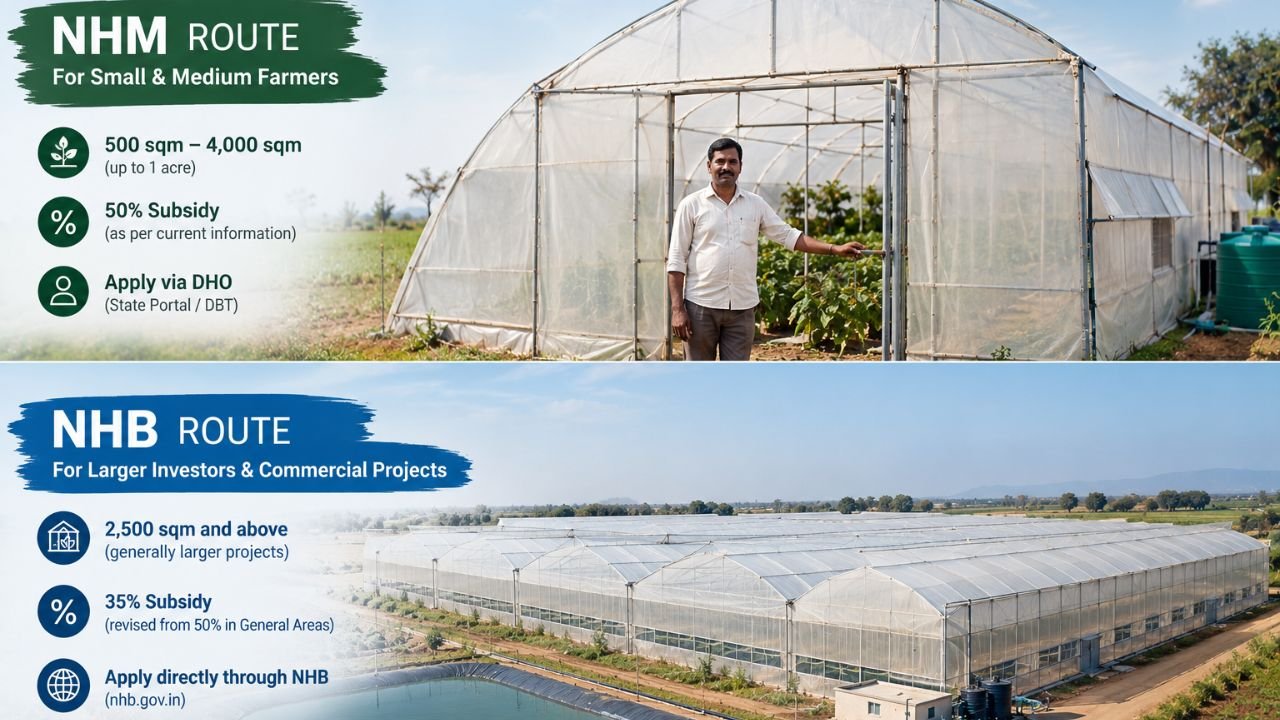
| Who it’s for | Small and medium farmers | Larger commercial projects and investors |
| Structure area range | 500 sqm to 4,000 sqm (roughly up to 1 acre) | Generally 2,500 sqm and above |
| Current subsidy rate (as of Aug 2026) | 50% of fixed cost norm (appears unaffected by the recent revision) | 35% in General Areas (revised down from 50%) |
| Assistance cap | Based on area and cost norm, no separate large cap typically needed at this scale | Capped around ₹1 crore per project |
| Where you apply | District Horticulture Officer (DHO), often via your state’s DBT portal | Directly through NHB (nhb.gov.in) |
| Typical applicant profile | First-time, 1-acre or smaller individual farmers | Larger landholders, agri-entrepreneurs, companies, FPOs scaling up |
| Processing/approval complexity | Generally simpler, closer to local administration | More involved, central-level documentation and scrutiny |
A Quick Way to Check Which One Applies to You
Ask yourself these in order, and you’ll usually land on the right answer within a minute:
Is your planned structure under 4,000 sqm (roughly 1 acre)? If yes, you’re very likely in NHM territory, and based on current information, the recent subsidy revision probably doesn’t touch your rate.
Is your planned structure 2,500 sqm or larger, with a total project cost well into the lakhs or crores? You’re likely in NHB territory, and this is exactly the segment affected by the drop from 50% to 35%.
Is your project somewhere in between, or are you unsure which category you fall into? This is genuinely common, and it’s worth a direct call to your DHO or a check with NHB before you assume either way — don’t let an assumption shape your entire project budget.
What This Means in Real Rupees for Two Different Farmers
Take two hypothetical farmers with genuinely different scales of ambition, and the contrast becomes clear.
Subsidy at 50%: ₹17.5 lakh
Based on current information, this rate appears unaffected by the August 2026 revision
Investor B — 3-acre commercial polyhouse, project cost ₹1.2 crore, applying through NHB:
Subsidy at the old 50% rate would have been ₹60 lakh (though capped around ₹1 crore per project in practice)
Subsidy at the new 35% rate: roughly ₹42 lakh
Difference: approximately ₹18 lakh less support for the same project
Farmer A’s plans likely proceed exactly as they would have before this news broke. Investor B needs to seriously recalculate financing, margin money, and break-even timelines before moving forward — a genuinely different conversation for a genuinely different scale of project.
A Word on “Just Staying Under the NHM Limit”
We’ve had a few people ask whether they should simply keep their project just under the NHM threshold to access the better rate, even if their original ambition was larger. This is worth thinking through honestly rather than purely as a subsidy-optimisation exercise. Artificially shrinking a project’s genuine scale — or worse, splitting land or filings to appear smaller than the actual operation — risks running into eligibility problems during inspection and can create real legal and compliance issues beyond just losing the subsidy. If your genuine business case calls for a larger project, plan around the correct route’s real numbers rather than trying to game a threshold; if a smaller, genuinely 1-acre-scale project actually suits your goals and budget better, that’s a legitimate reason to choose NHM on its own merits.
Why This Confusion Keeps Happening
Part of the reason NHM and NHB get mixed up so easily is that both fall under the same MIDH umbrella in government communication, and news coverage of scheme changes doesn’t always specify which route is affected — exactly what’s happened with this recent revision. A lot of secondhand reporting and WhatsApp-forwarded news has understandably (if inaccurately) suggested “polyhouse subsidy got cut” as a blanket statement, when the reality is route-specific. If you’re applying through your District Horticulture Officer, always ask them to confirm which specific scheme and current rate applies to your exact project size — don’t rely on general news headlines to make your financial decisions.
Frequently Asked Questions
How do I find out for certain which route my project falls under?
The clearest way is to directly ask your District Horticulture Officer for NHM eligibility, or check with NHB (nhb.gov.in) for NHB eligibility, giving them your exact planned structure area and project cost. Don’t rely solely on the general area thresholds in this article without confirming your specific case.
Can I apply through both NHM and NHB for the same project?
Generally, no — these are distinct schemes meant for different project scales, and double-claiming subsidy on the same project across schemes is typically not permitted. Confirm with your DHO or NHB if your situation seems to straddle both categories.
Is NHM subsidy guaranteed to stay at 50%, or could it also get revised?
We can’t guarantee any scheme rate is permanent — government guidelines are revised periodically, and this specific NHB revision shows rates can change. Based on current information, NHM appears unaffected by this particular change, but it’s worth confirming the current rate at the time you actually apply.
If I start small under NHM, can I later expand into NHB territory?
Expanding an existing operation is generally possible, though a later expansion would typically be evaluated as its own project against whatever scheme guidelines are current at that time, not necessarily inheriting your original NHM terms.
Scheme structures, area thresholds, caps, and rates are set by respective government bodies and are revised periodically. Figures in this article are indicative as of August 2026 — please confirm current terms directly with your District Horticulture Officer or NHB before making project or financing decisions.
Not sure which route fits your project?
AgroDome can help you figure out whether NHM or NHB applies to your plans, and what the real numbers look like either way.
Get a Free Consultation