
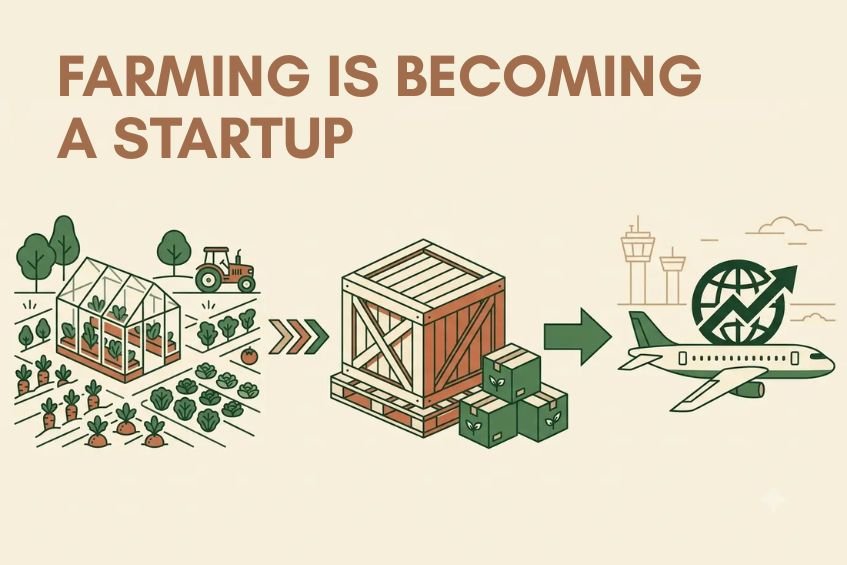
Ask any farmer what keeps them up at night, and hail, an untimely downpour, or a pest outbreak wiping out months of work will come up long before anything about markets or prices. That’s just how farming has worked for generations — you plant, you hope, and you wait to see what the sky decides to do with your effort.
But something is shifting. Quietly, in villages across Gujarat, Rajasthan, and Madhya Pradesh, farmers are starting to think less like laborers waiting on the weather, and more like entrepreneurs running a business with predictable inputs and outputs. And three things are making that shift possible right now: crop protection technology that actually works, government support that’s easier to reach than most people assume, and a global market that wants exactly what India can grow.
This isn’t a sales pitch dressed up as inspiration. It’s a fairly practical look at how these three pieces fit together — and why this particular moment might be the right one to stop treating farming as a gamble and start treating it as a business.
Farming Is Becoming a Startup, Whether We Call It That or Not
Think about what a startup actually is at its core: someone takes raw inputs, runs them through a controlled, repeatable process, and produces something worth more than the sum of its parts. That’s precisely what a polyhouse or a shade-net structure does to a piece of land.
Open-field farming is closer to a lottery ticket — you’re betting on rainfall, temperature, and the absence of a rogue hailstorm. A protected structure removes most of that randomness. You control humidity, filter the sunlight, manage pests with a physical barrier instead of guesswork, and you can plan your harvest calendar instead of hoping for one.
That predictability is exactly what turns a farm into a business you can actually plan around — one where you can calculate a return, take a loan against future income with some confidence, and even switch crops between seasons without tearing down what you built. Grow tomatoes this season, capsicum the next, and the same structure keeps earning for you.
Crop Protection Isn’t Just Insurance — It’s Where the Income Comes From
It’s easy to think of crop protection structures as a defensive purchase, like insurance you hope you never need to use. In practice, they’re closer to an upgrade in your production line. Farmers who move to naturally ventilated polyhouses or shade-net houses commonly see yields climb two to four times over open-field numbers, simply because the plant is no longer fighting the weather to survive.
There’s a quieter benefit too: consistency. Buyers — especially the export buyers we’ll get to shortly — don’t just pay for taste. They pay for uniform size, consistent color, and produce that hasn’t been scarred by wind or pests. A controlled environment is what makes that consistency possible at scale, season after season, instead of as a lucky exception.
What protection actually changes, in plain terms
- Yield: Higher and steadier, because the plant spends its energy growing instead of surviving.
- Water use: Drip and micro-irrigation inside a controlled structure typically use far less water than open-field flooding.
- Pest pressure: A physical barrier means fewer chemical sprays and lower input costs over time.
- Crop quality: Uniform size and appearance — the difference between selling in a local mandi and qualifying for a supermarket or export contract.
Government Support at a Glance
Here’s the part most farmers never get a straight answer on — which scheme actually applies to a protected cultivation project, and who runs it.
| Scheme | Who Runs It | What It Supports | What to Expect |
|---|---|---|---|
| MIDH (Mission for Integrated Development of Horticulture) | State Horticulture Departments | Polyhouses, shade-net houses, drip irrigation | Partial subsidy on project cost; percentage varies by state and farmer category |
| NHB (National Horticulture Board) | National Horticulture Board | Larger-scale protected cultivation projects | Capital cost subsidy, assessed project-by-project |
| PM-KUSUM | Ministry of New & Renewable Energy | Solar pumps and irrigation infrastructure | Subsidized solar-powered irrigation setups |
| Agriculture Infrastructure Fund | NABARD and partner banks | Farm infrastructure and post-harvest loans | Interest subvention on eligible loans |
| NABARD Refinance | NABARD, via nationalized banks | Refinancing bank loans for farm structures | Lower effective interest rates on borrowed capital |
Subsidy percentages, ceilings, and eligibility change by state and financial year. Always confirm current figures with your state horticulture department or a bank before budgeting a project around them.
Making Sense of the Loan and “PM Yojana” Conversation
Most farmers hear “PM Yojana” as a catch-all term for government help, and honestly, that’s not far off — it usually refers to whichever national or state scheme is currently supporting horticulture, irrigation, or rural infrastructure. The details worth knowing are simpler than they sound:
- You rarely fund 100% of a project yourself. Subsidies typically cover a meaningful share of the cost, with the rest financed through a bank loan or your own contribution.
- Categories matter. Small and marginal farmers, women, and SC/ST applicants often qualify for a higher subsidy ceiling than the general rate.
- Paperwork is the real bottleneck, not eligibility. Land documents, a project report, and a bank account in good standing are usually enough to start — but incomplete applications are the most common reason for delays.
- Local offices know more than the website. A visit to your district horticulture office, or a conversation with a company that’s filed these applications before, saves most of the back-and-forth.
None of this means the process is effortless. But it’s far more accessible than the assumption that “subsidies are for someone else” — which is the single biggest reason genuinely eligible farmers never apply.
The Export Opportunity: Growing What India Currently Imports
Here’s the part of this story that doesn’t get told enough. India spends real money importing high-value produce it could be growing at home — certain berries, exotic vegetables, and off-season fruit among them. At the same time, global demand for consistently grown, export-grade produce keeps climbing.
Blueberries are a good example of where this is heading. It’s a market worth roughly $12 billion globally, and Indian growers are only just beginning to enter it — largely because blueberries need exactly the kind of climate-controlled, precision-managed environment that a modern tunnel or multi-span structure provides. The same logic applies to capsicum, cucumber, and several fruit varieties that fetch a premium once they meet export specifications.
The opportunity here isn’t abstract. It’s the difference between selling a crop in the nearest local market at whatever price is offered that day, and selling into a supply chain that pays for consistency, quality, and reliability — the same qualities a protected structure was built to deliver in the first place.
Frequently Asked Questions
Do I need a large farm to start a protected cultivation business?
Not necessarily. Many successful projects start on a single acre or even less. What matters more than size is choosing a structure and crop that match your land, water source, and target market.
How much government subsidy can I actually get?
It depends on your state, the scheme, and your farmer category — figures typically range from around 50% upward, with some categories qualifying for more. These numbers change yearly, so it’s worth confirming the current rate before you plan a budget.
Is a bank loan necessary, or can subsidy alone cover the project?
Subsidies usually cover part of the cost, not all of it. Most farmers combine a subsidy with a bank loan or their own savings to fund the remainder.
Which crops give the best returns for export?
High-value crops like blueberries, capsicum, cucumber, and certain exotic fruits tend to command export-grade premiums, but the right choice depends on your climate, structure type, and access to a buyer or export partner.
How long before I see returns on a protected cultivation investment?
Many growers start seeing a return within 12 to 24 months, though this varies with crop choice, structure size, and how quickly a stable buyer relationship is established.
Where do I even start the application process?
Begin with your district horticulture office or your state’s horticulture department portal. Having your land documents and a basic project plan ready before you apply speeds things up considerably.
Inside the Structure
A naturally ventilated polyhouse — controlled climate, uniform rows, predictable output.
Shade-net structures reduce sunlight and airflow stress while keeping crops visible and manageable.
From Farm to Export
Uniform, export-grade produce ready for grading and packing.
The same crate, now on its way to a market that pays for consistency.
Thinking About Starting Your Own Protected Farming Project?
Agrodome helps farmers navigate structure design, subsidy paperwork, and agronomy support from the first conversation to the first harvest.
Talk to Our Team