
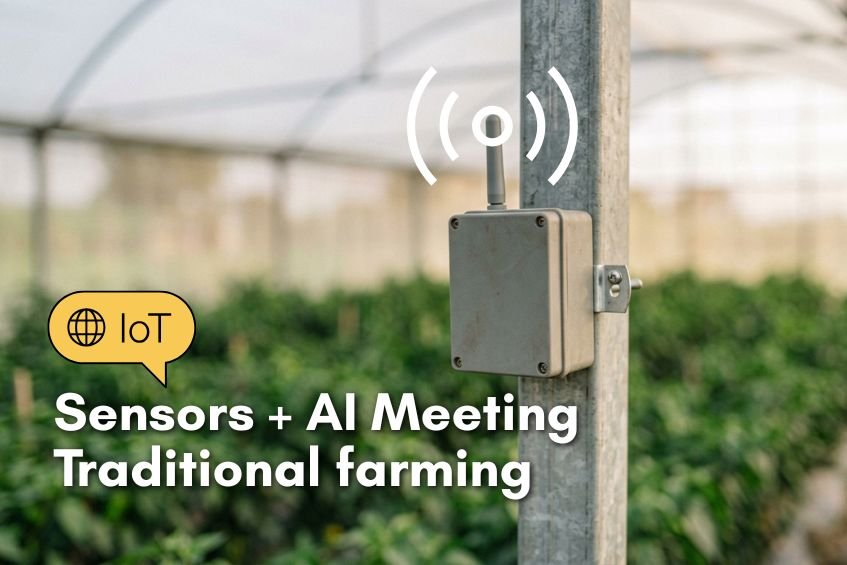
Most agritech coverage talks about drones and satellite data for open fields. Here’s what’s actually changing inside the polyhouse itself.
Every time “AI in agriculture” comes up online, the conversation jumps straight to drones flying over wheat fields or satellites tracking soil moisture across thousands of acres. That’s real, but it’s not really our world. Polyhouse and greenhouse farming operates on a completely different scale — a few thousand square meters, tightly controlled, and honestly a much better environment for sensors and automation to actually prove their worth. Here’s what’s genuinely changing, without the exaggerated “farms will run themselves” framing you’ll see elsewhere.
Climate Sensors: The Foundation Everything Else Builds On
This is the least flashy part of smart greenhouse technology, and also the most useful. Simple IoT sensors placed inside the polyhouse continuously track temperature, humidity, soil moisture, light levels, and CO2 concentration — feeding this data back to a farmer’s phone in real time. What used to require someone physically walking the length of the structure a few times a day, checking gauges and guessing, is now a glance at an app.
The real value isn’t the data itself — it’s what it lets you catch early. A slow rise in humidity that would eventually invite fungal disease. A temperature spike during the hottest part of the day that would stress the crop before you’d normally notice. Farmers using these systems aren’t managing smarter after the fact; they’re catching problems before they become visible to the eye.
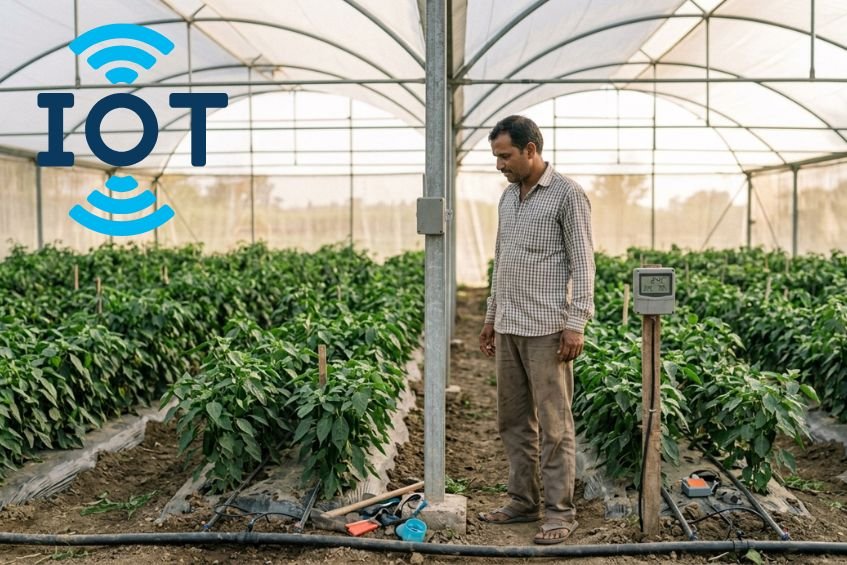
Automated Fogging, Irrigation and Ventilation
This is where sensors stop just reporting and start actually acting. Once temperature or humidity crosses a threshold you’ve set, the system can automatically trigger fogging, turn on exhaust fans, or open ventilation — without anyone needing to be physically present or manually flip a switch. The same logic applies to irrigation: soil moisture sensors combined with an automated drip and fertigation setup mean water and nutrients get delivered on the plant’s actual need, not a fixed daily schedule that might overwater on a cool day or underwater on a hot one.
Farmers who’ve adopted this report a genuinely practical benefit — they’re not tied to the polyhouse every single hour. A trip to town, a family event, an early night’s sleep, all become less risky when the system is watching temperature and moisture even when you’re not.
Remote Monitoring Apps: Managing From Your Phone
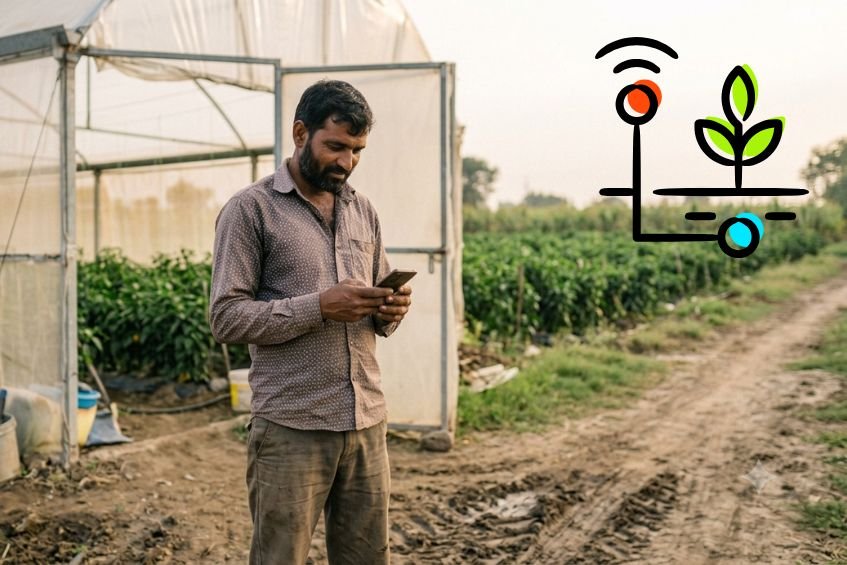
This is probably the most immediately useful piece of technology for a working farmer today. A basic smartphone app connected to your sensor network lets you check your polyhouse’s conditions from anywhere with an internet connection — whether you’re at the mandi, at home, or traveling. Some systems send direct alerts when something needs attention: a water level dropping at the source, a temperature exceeding your set limit, a moisture sensor reading outside the normal range.
This matters more in Indian conditions than it might elsewhere, because it directly reduces one of the biggest hidden costs of polyhouse farming — needing someone physically present around the clock. A well-set-up remote monitoring system means one person can realistically oversee a farm without living inside the greenhouse.
Where AI Is Actually Adding Value (And Where It’s Still Early)
“AI-powered greenhouse” gets used loosely in a lot of marketing, so it’s worth being specific about where it genuinely helps today. Researchers and larger commercial operations are using AI models for things like early disease and pest detection from camera images, yield estimation based on growth patterns, and predictive climate modeling that adjusts systems before conditions drift out of range rather than reacting after. These applications are real and improving quickly.
Where it’s genuinely still early, especially for small and mid-sized Indian farms: fully autonomous decision-making without human oversight, and robotic harvesting. Both exist in research settings and select large commercial operations, but they’re not yet a practical, affordable option for a typical 1-acre Indian polyhouse. If someone’s pitching you a fully “self-running AI farm” for a standard-size project right now, that’s more marketing language than current reality.
The Honest Trade-Off: Cost vs Benefit for a Small Farmer
None of this technology is free, and it’s fair to ask whether it’s worth it on a modest 1-acre setup. Basic sensor and automation packages have become considerably more affordable in recent years — a basic climate monitoring and automated irrigation setup is no longer reserved for large commercial farms only. That said, more advanced AI-driven systems with disease detection and predictive modeling still carry a meaningful cost premium, and the return on that investment depends heavily on your crop’s value and your farm’s scale.
Our honest recommendation for most first-time or small-scale farmers: start with solid basic sensors and automated irrigation — this alone solves the biggest daily pain points and pays for itself through labour savings and fewer crop losses. Layer in more advanced AI tools later, once you’ve got a season or two of experience and a clearer sense of where the technology would actually move the needle for your specific crop.
Getting the Basics Right First
Technology works best on top of a well-designed structure, not as a patch for a poorly planned one. A properly planned polyhouse project — with the right ventilation, cooling, and irrigation layout from the start — makes every sensor and automation system you add later far more effective. And since several of these upgrades qualify for support under existing subsidy schemes, it’s worth factoring smart technology into your project budget from day one rather than treating it as an expensive afterthought.
Frequently Asked Questions
Is smart greenhouse technology affordable for a small farmer in India?
Basic sensor and automation setups have become significantly more accessible in recent years and are a realistic addition even for a 1-acre polyhouse. More advanced AI-driven systems still carry a higher cost and typically make more sense for larger or higher-value operations.
Do I need technical knowledge to run a sensor-based polyhouse?
Not really — most modern systems are designed with simple smartphone apps meant for everyday use, not technical operators. Basic comfort with a smartphone is generally enough to manage day-to-day monitoring and alerts.
Can AI actually detect crop diseases before I notice them myself?
Camera-based AI disease detection is a genuinely active and improving area, capable of spotting early signs before they’re obvious to the naked eye in some cases. It’s not infallible, and it works best as an early-warning layer alongside regular manual crop inspection, not a replacement for it.
Will this technology work reliably in areas with unstable internet or power?
This is a genuine limitation worth planning for — cloud-based monitoring depends on stable connectivity, and rural areas can have inconsistent internet access. Solar backup for power and systems with some offline/local functionality are worth discussing with your technology provider before committing.
Technology capabilities and costs in this space are evolving quickly. This article reflects a general picture as of 2026 — please get current product-specific details from your technology provider before making investment decisions.
Curious what smart technology makes sense for your polyhouse?
AgroDome can walk you through which sensors and automation actually pay off for your crop and scale — no unnecessary upsells.
Get a Free Consultation