
The global blueberry market is heading toward $13 billion. That’s real. What it means for your 1-acre plot in India is a different, more nuanced question — let’s actually answer it.
Blueberry has become the crop everyone’s suddenly talking about — and the “$12 billion global market” line gets thrown around constantly to justify it. It’s not wrong; the global blueberry market is genuinely projected to approach $13 billion by 2030. But a growing global market and a profitable acre in Gujarat or Himachal are two different things connected by a lot of hard, technical work in between. Here’s the honest breakdown.
Why the Opportunity Is Real
This part genuinely holds up. India imports more than 20,000 metric tons of blueberries every year, while domestic production sits at roughly 1,000–2,000 metric tons — a massive supply gap. Compare that to Peru, which has over 16,000 hectares under blueberry cultivation, and it’s clear India’s blueberry industry is still in its early stages relative to demand. Global production crossed 2 million tons in 2024, and India’s own berry market is expanding steadily as urban consumers develop a taste for it. The gap between demand and domestic supply is the actual opportunity — not the headline global market number by itself.
What It Actually Costs to Set Up
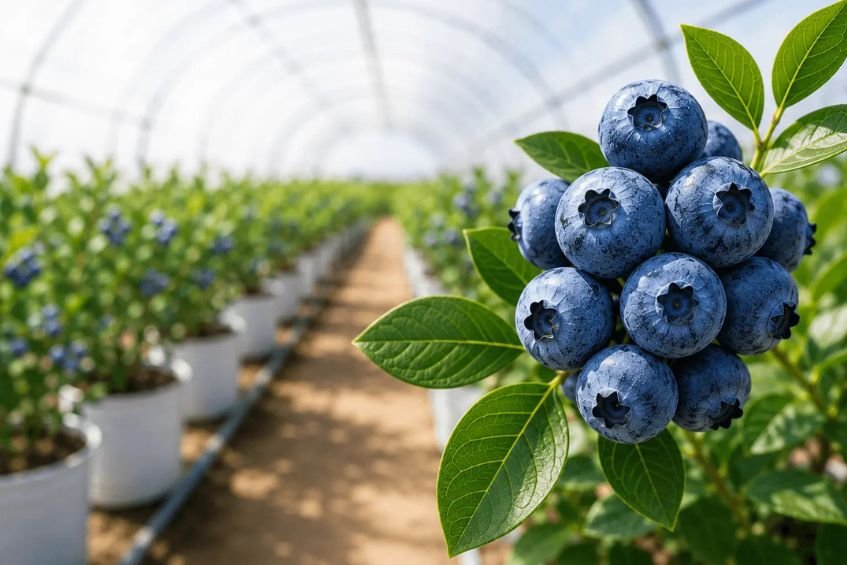
Most successful Indian blueberry operations grow the crop in soilless grow bags under poly tunnels rather than in open ground, since blueberries need acidic soil conditions that Indian soils rarely provide naturally. This drives the setup cost meaningfully higher than a standard vegetable polyhouse.
Basic setup (tunnel, grow bags, younger plants): ₹25–35 lakh
Fuller commercial setup (better genetics, automation, older/faster-fruiting plants): ₹50–75 lakh
Plants alone: roughly 1,000–1,500 per acre, at ₹200–500 each depending on age and variety
Ongoing operational cost once established: ₹3–5 lakh per year (labour, irrigation, fertilization, pest management)
That’s a wide range, and the reason is simple — younger, cheaper plants take longer to reach full fruiting, while more mature, pricier plants fruit sooner but cost significantly more upfront. There’s no universally “right” choice here; it depends on how much patience versus capital you have.
Yield and Revenue: The Patience Curve
Blueberry is not a fast crop, and anyone telling you otherwise is skipping the hard part. Yield builds gradually over several years before a plant hits its stride:
| Year | What to expect |
|---|---|
| Year 1 | Little to no commercial yield — plants are establishing root systems |
| Year 2–3 | Yield ramps up gradually; some income starts, but well below mature levels |
| Year 4 onward (maturity) | Full production — 5 to 10 tonnes per acre is a realistic mature yield range, with well-managed high-density plantings reaching higher |
At maturity, with wholesale prices commonly falling somewhere between ₹300 and ₹1,000 per kilogram depending on quality and market channel, gross revenue on a mature acre can be substantial. After realistic operational costs, a well-managed farm’s net profit at maturity typically lands in the ₹15–30 lakh per acre range — genuinely excellent for a farm crop, but nowhere near some of the more sensational figures circulating online.
About Those “₹50–64 Lakh Per Acre” Claims
You’ll come across YouTube videos and blog posts promising ₹50 lakh, even ₹64 lakh per acre from blueberry farming. These aren’t necessarily fabricated — they’re usually built on the highest end of the wholesale price range (₹1,200–2,000/kg premium pricing), the highest end of yield, and a best-case export or premium-retail channel, all stacked together. That combination is achievable for some growers with excellent execution and market access, but it’s the ceiling, not the median. Budget your decision around the ₹15–30 lakh realistic range, and treat anything higher as a pleasant surprise rather than a plan.
The Three Things That Make or Break This Crop
Soil and water acidity. Blueberries need distinctly acidic growing conditions, which is precisely why most Indian growers use soilless grow bags with acidified substrate rather than fighting native soil pH. Your irrigation water also needs to be low in salinity — generally under 0.8 mS/cm EC — or you’ll need to treat it, adding to your ongoing costs.
Variety selection for your climate. Not every blueberry variety suits every Indian region. Low-chill varieties bred for warmer climates matter enormously if you’re not farming in a naturally cold zone like Himachal or parts of the Nilgiris — planting the wrong variety for your local winter chill hours is one of the most common and costly early mistakes.
Securing your market before you plant, not after. Blueberries move through a few distinct channels in India — modern retail chains actively sourcing domestic fruit, direct-to-consumer sales, and a smaller export segment. Each has different price points and different requirements around consistency, packaging, and volume. Farmers who line up a buyer relationship before their first harvest consistently do better than those who plan to “figure out selling later.”
So, Is It Actually Profitable?
Yes — for the right farmer, in the right location, with the patience to wait 3 to 5 years for real returns and the discipline to get water quality, soil acidity, and variety selection right from day one. It is not a crop for someone who needs cash flow in year one, and it is not the guaranteed ₹50-lakh windfall some content suggests. Treat it as a serious, technically demanding long-term investment, and the underlying opportunity — that large gap between Indian demand and Indian supply — is genuinely there to be captured.
Frequently Asked Questions
How long before a blueberry farm starts making money?
Meaningful income typically starts building from year 2–3, with full maturity and peak yield generally arriving from year 4 onward. Break-even on the total investment usually takes 3 to 5 years.
Can blueberries be grown in Gujarat’s climate?
It requires careful planning — Gujarat’s heat and typically alkaline, sometimes saline groundwater are both challenges for blueberries. Low-chill varieties combined with proper soilless growing media and treated irrigation water can make it work, but it demands more upfront engineering than growing it in a naturally cooler, higher-altitude region.
Is blueberry farming eligible for MIDH or NHB subsidy?
High-value fruit crops under protected cultivation are generally eligible for support under horticulture schemes, though the exact structure and equipment covered can vary. Check current eligibility for grow-bag/tunnel-based blueberry setups with your District Horticulture Officer.
Is blueberry more profitable than capsicum or cucumber per acre?
At maturity, blueberry’s per-acre profit potential is generally higher than capsicum or cucumber’s. But it requires far more patience (years, not months, before real returns), higher upfront investment, and more technical management — it’s a different risk category, not simply a “better” version of the same decision.
Figures in this article are indicative estimates for 2026, drawn from industry data and field experience. Actual yield, price, and profit depend heavily on variety, location, water quality, and market access. Please consult our team for a project-specific assessment before making investment decisions.
Considering blueberry for your land?
AgroDome can assess your water quality, climate zone, and budget to tell you honestly whether blueberry is the right fit — or whether another crop makes more sense to start with.
Get a Free Consultation