
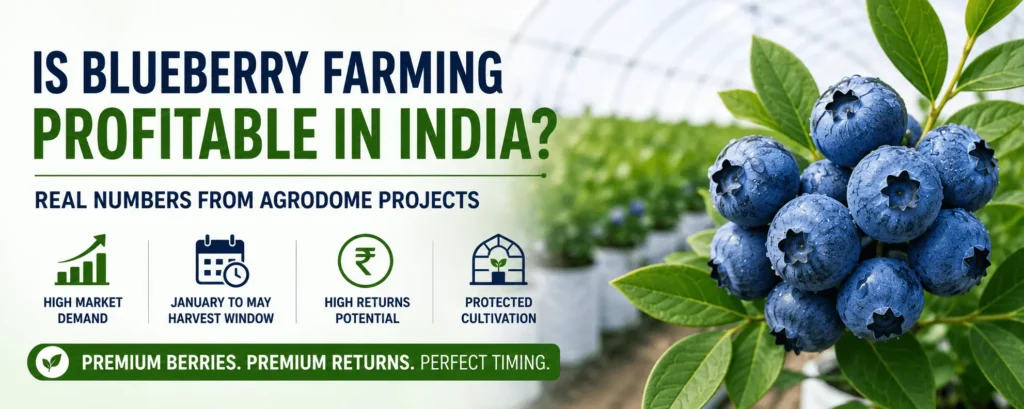
Every farmer or investor who walks into an AgroDome consultation asks the same question first: ‘Is blueberry farming actually profitable in India, or is it just hype?’
It is a fair question. Blueberries are still a relatively new crop in Indian agriculture, they demand a specific growing environment, and the setup costs are higher than conventional farming. So before anything else, let us answer it with real numbers — from real projects.
The Market Case: Why Blueberries, Why Now
India currently imports the vast majority of its premium blueberries. The domestic retail price of imported blueberries ranges from ₹400 to ₹1,000+ per kg depending on quality, season, and origin. Meanwhile, the global blueberry market — valued at approximately USD 8.5 billion today — is projected to cross USD 12 billion by 2030, growing at a CAGR of 7%.
That growth is driven not just by fresh consumption but by exploding demand in nutraceuticals, functional foods, natural skincare, frozen (IQF) processing, and the global bakery and dairy sectors.
The key insight: India has a natural counter-seasonal advantage. While Peru and Chile harvest from September to December, and USA and Poland from July to September, India’s harvest window runs from January to May — exactly when European and Middle Eastern markets face their biggest supply gaps and pay their highest prices.
What Does Blueberry Farming Actually Cost in India?
Let us be direct. Blueberry farming is a capital-intensive, high-reward investment. This is not a crop for zero-investment farming. However, it is a crop where the returns, when managed correctly, significantly outperform conventional horticulture.
Here is an indicative cost breakdown for one hectare of blueberry farming under an AgroDome multi-span tunnel system:
| Cost Component | Estimate (per hectare) | Notes |
| Tunnel structure & covering | ₹18–25 Lakhs | AgroDome multi-span design |
| Substrate & grow bags | ₹6–10 Lakhs | Cocopeat + Peat Moss blend |
| Drip fertigation + fogging | ₹4–7 Lakhs | Smart irrigation system |
| Planting material (varieties) | ₹8–15 Lakhs | Biloxi, Emerald, Sekoya Pop® |
| Site prep & soil analysis | ₹1–2 Lakhs | Including pH correction |
| Agronomic support (Year 1) | ₹2–4 Lakhs | IPM, fertigation scheduling |
| Miscellaneous & contingency | ₹2–3 Lakhs | 10–15% buffer recommended |
| Total estimated setup cost | ₹41–66 Lakhs | Varies by location & scale |
Note: These are indicative figures based on AgroDome’s project experience across Gujarat, Rajasthan, Telangana, and Madhya Pradesh. Actual costs vary based on land, water quality, state subsidies, and chosen variety. AgroDome provides a customised feasibility report for each project.
Can Government Subsidies Reduce This Cost?
Yes, significantly. Under the National Horticulture Mission (NHM) and PM-KISAN linked schemes, farmers can access subsidies of 40–50% on polyhouse and protected cultivation structures in many states. AgroDome’s project management team actively assists clients in navigating these subsidy applications, which can reduce net setup costs by ₹10–25 Lakhs per hectare depending on the state.
What Are the Revenue and Profit Projections?
AgroDome’s substrate-based blueberry system targets a yield potential of 15 to 25 tonnes per hectare at full maturity (Year 2 onwards). Here are three scenarios based on market pricing:
| Scenario | Yield / Ha | Price / Kg | Gross Revenue / Ha | Net Profit (est.) |
| Conservative | 15 tons | ₹400 | ₹60 Lakhs | ₹20–25 Lakhs |
| Moderate | 20 tons | ₹500 | ₹1 Crore | ₹40–50 Lakhs |
| Optimistic | 25 tons | ₹600+ | ₹1.5 Crore | ₹70–85 Lakhs |
Important context: First harvest typically occurs 12–18 months after planting. Year 1 is primarily an investment year. By Year 3, a well-managed AgroDome project running at moderate scenario assumptions can fully recover setup costs and generate positive cash flow.
The AgroDome Advantage: What Makes These Numbers Achievable?
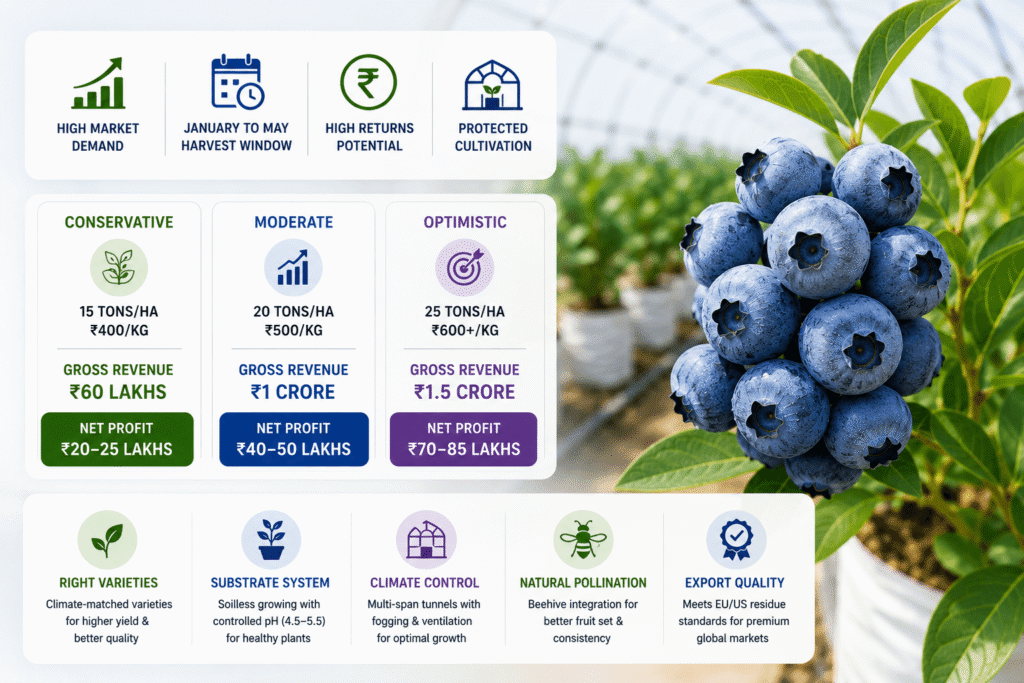
Many farmers have tried blueberry cultivation in India and failed — usually because of three reasons: wrong variety selection, improper soil pH management, and inadequate climate control. AgroDome addresses all three systematically.
1. Variety Selection Matched to Your Climate
AgroDome works with two categories of varieties based on your region:
- Zero to Low-Chill Varieties (Central & South India): Biloxi, Emerald, Sekoya Pop®, and Ventura. These tolerate temperatures up to 40°C and thrive in Gujarat, Rajasthan, Maharashtra, and Telangana.
- Mid to High-Chill Varieties (Northern Hill Regions): Duke, Bluecrop, and Sekoya Crunch®. Ideal for Himachal Pradesh, Kashmir, and Uttarakhand with 600–1,000+ chill hours.
Using the wrong variety in the wrong climate is the single biggest reason blueberry projects fail in India. AgroDome’s agronomy team conducts site analysis before a single plant goes in the ground.
2. Precision Substrate System — No Soil, No Contamination
Blueberries require a strict soil pH of 4.5 to 5.5. In most Indian soils, achieving and maintaining this is extremely difficult. AgroDome eliminates this problem entirely through a soilless substrate system:
- Growing media: Premium Cocopeat + Peat Moss blend
- Container: High-drainage grow bags (10L to 25L) for precise root zone control
- Plant density: 8,000 to 12,000 plants per hectare
- Result: Zero soil contamination, zero soil-borne disease risk, and full compliance with EU/US export residue limits
3. Climate-Controlled Tunnel Structures
AgroDome’s proprietary multi-span tunnel designs are purpose-built for blueberry cultivation in Indian conditions:
- Tunnel span width: 8–10 metres
- Tunnel height: 4–6 metres for optimal heat venting
- Top covering: Ventilated poly film + insect netting + apron sheet
- Irrigation: Advanced drip fertigation combined with fogging systems for climate control
- Pollination: Beehive integration within tunnels for natural, consistent fruit set
The result is a stable 15°C–32°C growing environment that can handle ambient temperatures up to 40°C — making viable blueberry production possible in Rajasthan and Gujarat, which would otherwise be climatically unsuitable.
Who Is This Farming Model For?
Based on AgroDome’s project portfolio — which includes clients like the Patanjali Group, Dhanuka Group, IG International, and individual growers across India — the blueberry programme typically suits three types of investors and farmers:
- Progressive farmers with 1–5 acres looking to shift from low-margin crops to a premium horticultural product with export potential.
- Agri-investors and agribusiness entrepreneurs seeking a structured, data-driven crop with predictable ROI and a growing global market.
- Corporate agribusiness groups looking to build traceable, export-grade berry supply chains with IPM certification and EU residue compliance.
The Blueberry Farming Timeline: What to Expect Year by Year
- Month 1–3: Site selection, soil analysis, water quality testing, tunnel design, subsidy application, and structure installation.
- Month 4–6: Substrate preparation, grow bag setup, planting of selected varieties, drip fertigation commissioning.
- Month 7–12: Crop establishment phase. Vegetative growth, IPM monitoring, fogging calibration, beehive introduction.
- Month 12–18: First harvest. Smaller yield in Year 1, primarily for quality assessment and market establishment.
- Year 2 onwards: Full production. Target yield of 15–25 tonnes per hectare. Export window alignment to February–May for Europe and Middle East markets.
Blueberry Farming in India: Frequently Asked Questions
Is blueberry farming profitable for small farmers in India?
Yes, but only with the right infrastructure and variety selection. A 1-acre blueberry farm under AgroDome’s system, at moderate yield and pricing assumptions, can generate ₹15–20 Lakhs in gross revenue annually from Year 2 onwards. After operating costs, net profitability depends on water quality, market access, and variety performance.
What is the minimum investment for blueberry farming in India?
For a 1-acre (approximately 0.4 hectare) pilot project, expect a total setup investment of ₹18–28 Lakhs inclusive of tunnel structure, substrate, planting material, and irrigation. Government subsidies under NHM can reduce this by 40–50% in eligible states.
Which states in India are best for blueberry farming?
For zero to low-chill varieties (Biloxi, Emerald, Sekoya Pop®): Gujarat, Rajasthan, Maharashtra, Karnataka, Telangana, and Tamil Nadu. For high-chill varieties (Duke, Bluecrop, Sekoya Crunch®): Himachal Pradesh, Jammu & Kashmir, and Uttarakhand.
How does blueberry production in India compare globally?
India is positioned to become a significant counter-seasonal supplier. While Peru, Chile, and Spain dominate global exports, India’s January–May harvest window represents a gap period when European and Middle Eastern buyers face premium-priced supply shortages. Indian-grown blueberries meeting EU/US residue standards can command premium FOB pricing during this window.
What blueberry varieties work best in Indian conditions?
AgroDome recommends Biloxi and Sekoya Pop® for most of peninsular and central India due to their heat tolerance and premium fruit quality. Sekoya Pop® is particularly notable for its jumbo berry size and 60-day shelf life — qualities that make it highly competitive for fresh export.
Ready to Get Real Numbers for Your Land?
Every site is different. Soil composition, water EC levels, local climate, and available infrastructure all affect the actual profitability of a blueberry farm. The numbers in this article are based on AgroDome’s project experience across multiple geographies and are meant to give you a realistic starting point — not a fixed promise.
The most accurate picture of what blueberry farming could look like on your specific land comes from AgroDome’s customised feasibility report — a detailed site-specific analysis covering variety recommendation, tunnel design, yield projections, and investment recovery timelines.
Explore AgroDome’s complete Blueberry Orchard & Global Berry Program at agrodome.in/blueberry-orchard-global-berry-program or contact the team directly to request a free site visit.