
Choosing the right polyhouse structure is one of the most consequential decisions a farmer or agri-investor can make. Two designs dominate India’s protected farming landscape — the Dome Roof and the Flat Roof polyhouse. Each has its strengths, trade-offs, and ideal use cases. Here’s everything you need to know before you build.
India’s protected cultivation sector has grown dramatically over the last decade, driven by the need for higher crop yields, weather resilience, and year-round production. At AgroDome Projects LLP, we’ve designed and installed over 1,000 greenhouse structures across varied climates — from the arid plains of Rajasthan to the humid coastal belts of Gujarat and beyond. In that journey, one question comes up again and again: Dome or Flat?
The answer isn’t always obvious. It depends on your crop, your local climate, your budget, and your long-term farming goals. This guide breaks it all down clearly so you can make an informed decision.
Understanding the Two Structures
Before diving into comparisons, let’s understand what these structures actually are and how they work.
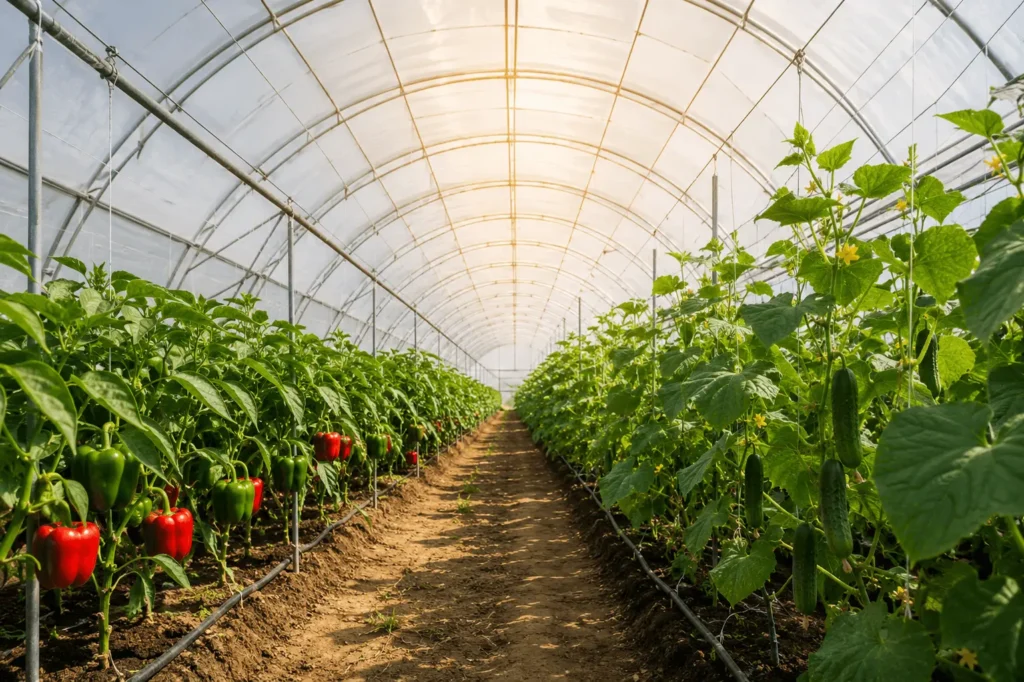
Features a curved, arched roof profile that distributes structural load evenly. The shape naturally channels rainwater off the sides and allows for superior air circulation. Commonly used for high-value crops requiring precise climate control.
Features a flat or very slightly sloped roof supported by a grid of columns and beams. Simpler to construct, cost-effective for large areas, and easy to maintain. Widely used for shade-net applications and low-growing crops.
Head-to-Head: Key Structural Differences
The table below compares both structures across the parameters that matter most to farmers and agri-entrepreneurs in India.
| Parameter | 🏛️ Dome Roof | 🏗️ Flat Roof |
|---|---|---|
| Structural Design | Curved arch, self-supporting | Horizontal beams on columns |
| Construction Cost | Moderate–High | Low–Moderate |
| Internal Height | High (5–8 m at peak) | Low–Medium (3–4.5 m) |
| Natural Ventilation | Excellent (ridge vents) | Moderate (side vents only) |
| Rainwater Drainage | Automatic (curved run-off) | Needs proper slope design |
| Wind Resistance | Very High | Moderate |
| Snow Load Handling | Excellent | Poor (snow pools on flat) |
| Light Distribution | Uniform across crop canopy | Can create shadow hotspots |
| Scalability | Moderate (span-limited) | Very High (unlimited bays) |
| Maintenance Access | Slightly complex (curved film) | Easy (flat surfaces) |
| Suitable for Poly Film? | Yes | Yes (with care) |
| Suitable for Shade Net? | Yes | Yes (ideal) |
| Ideal Crop Height | Tall (tomato, cucumber, capsicum) | Short–Medium (flowers, leafy) |
| Government Subsidy Eligibility | NHM/MIDH — Yes | NHM/MIDH — Yes |
Matching Your Structure to Your Climate
Climate is perhaps the single biggest deciding factor. Here’s how each structure performs across India’s diverse agro-climatic zones.
Best: Dome (NVPH) — ridge ventilation prevents heat build-up inside the structure.
Best: Dome Roof — curved surface sheds heavy rainfall instantly; no pooling risk.
Best: Dome Roof — arch design prevents snow accumulation and structural collapse.
Best: Flat Roof — cost-effective for large operations; manageable wind loads.
Best: Dome for tall crops; Flat Shade Net for low-growing crops to allow airflow.
Either works — decide based on crop height and budget rather than climate alone.
Which Crops Grow Best in Each Structure?
Your crop selection should directly influence your structure choice. Here’s a crop-by-crop breakdown based on growth habit, space requirements, and climate sensitivity.
Dome Roof
Dome Roof
Dome Roof
Flat Roof
Flat Roof
Dome Roof
Either Works
Flat Roof
Cost & Return on Investment
Budget is a real constraint for most Indian farmers. Here’s an honest breakdown of how costs compare:
Dome Roof Polyhouse
Due to the curved fabrication, specialized GI pipe bending, and higher-grade poly film requirements, dome structures typically cost 15–30% more per sq. metre than flat roof alternatives. However, this investment pays off in:
- Year-round production capability (not just seasonal)
- Higher-value crops that command better market prices
- Longer poly film lifespan due to reduced stress from water pooling
- Lower crop loss due to superior weather protection
- Eligibility for NHM and MIDH subsidies up to 50% of project cost
Flat Roof Polyhouse / Shade Net House
Flat structures offer a lower entry point with faster breakeven — ideal for farmers new to protected farming or those scaling existing operations on a budget.
- Lower capital expenditure per sq. metre of cultivated area
- Easier to expand incrementally (add bays over time)
- Minimal maintenance — flat surfaces are easier to inspect and repair
- Suitable for bulk commodity crops with stable market demand
Quick Decision Guide: Dome or Flat?
Use this simple framework to narrow down your choice before consulting with our team:
| Your Situation | Recommended Structure |
|---|---|
| Crops taller than 3 metres (tomato, cucumber, capsicum) | Dome Roof Polyhouse |
| High rainfall or snow-prone zone | Dome Roof Polyhouse |
| Large-scale flower or leafy vegetable production | Flat Roof Shade Net |
| Tight budget, first-time protected farm | Flat Roof (start here) |
| Export-quality berry or fruit production | Dome Roof (tunnel type) |
| Nursery / seedling operations | Flat Roof with shade net |
| Hybrid cropping system (tall + short crops) | Dome Multi-Span |
| Extreme heat zone (>40°C summers) | Dome with Fan-Pad cooling |
The Bottom Line
There is no universal winner in the dome vs. flat roof debate. Both structures have earned their place in Indian protected agriculture. The dome roof polyhouse excels when you’re growing tall, high-value crops in challenging climates and need maximum control over your growing environment. The flat roof structure wins when scale, cost-efficiency, and simplicity of operations are your priorities.
What matters most is that your structure is matched to your specific crop, your climate zone, your budget, and your long-term farming vision — not what’s simply popular or nearby. That’s where expert guidance becomes invaluable.
At AgroDome Projects LLP, we don’t just sell greenhouse structures. We design complete, customized protected farming solutions — from site analysis and structure selection to installation, agronomy support, and ongoing maintenance. With 14+ years of hands-on experience across India and internationally, we’ve helped over 1,000 farmers make the right choice and grow more profitably.
Not Sure Which Structure Is Right for You?
Our protected farming specialists offer free consultations to help you evaluate your crop, climate, land, and budget — and recommend the structure that will deliver the best returns for your specific situation.