
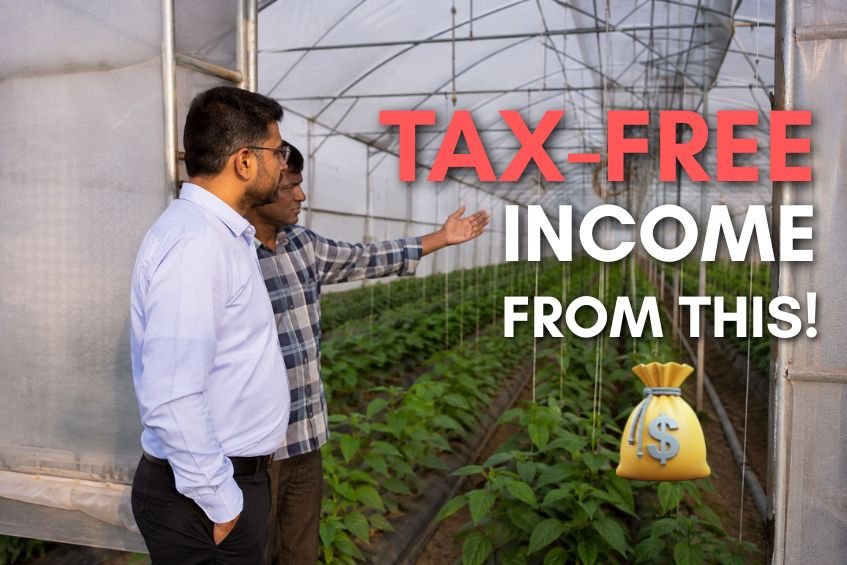
Agricultural income really is tax-exempt in India. But there’s more nuance to it than the one-line claim you’ve probably heard — here’s the accurate picture.
We talk to a fair number of shop owners, traders, and small business people who’ve heard, correctly, that agricultural income is tax-free in India — and who are now weighing whether to put some capital into a polyhouse project. The tax point is real, and it’s a genuine advantage. But it comes with conditions most people never hear about until they’re already filing their return. Let’s go through this properly, because getting it wrong on your ITR is a bigger headache than the tax saving is worth.
Yes, Agricultural Income Is Genuinely Exempt
Under Section 10(1) of the Income Tax Act, 1961, agricultural income earned in India is exempt from central income tax. This isn’t a loophole or a grey area — it’s a deliberate, long-standing constitutional arrangement, since agriculture falls under state jurisdiction rather than central taxation. Income from cultivating land, growing crops, vegetables, or fruit, and income from farm buildings required for agricultural operations, all fall within this exemption.
For a business owner comparing this to income from a shop, a trading business, or a services business — where every rupee of profit is taxed at your applicable slab rate — this is a genuinely meaningful structural difference, not a marketing exaggeration.
The Part Almost Nobody Explains: Partial Integration
Here’s the detail that trips people up. “Exempt” doesn’t mean agricultural income is invisible to the tax department if you also have other taxable income — like profit from your existing shop or business. If your net agricultural income exceeds ₹5,000 in a year AND you also have non-agricultural income above the basic exemption limit, a method called partial integration kicks in.
It does NOT tax your agricultural income directly.
It DOES add your agricultural income to your non-agricultural income temporarily, just to calculate what tax slab your non-agricultural income should fall into — then removes the agricultural income again before calculating the final tax.
Net effect: your agricultural income stays tax-free, but it can push your business income into a higher effective tax bracket than it would sit in on its own.
In plain terms — if you’re running a business and your farm income is meaningful, don’t assume your total tax bill won’t be affected at all. It usually still comes out favourably compared to earning that same amount purely through a taxable business, but it’s not a completely separate, invisible stream either.
What Actually Counts as “Agricultural Income” — This Matters More Than People Realise
This is where a lot of assumptions go wrong. Not everything connected to a farm automatically qualifies for the exemption. The core rule: the income needs to come from genuine agricultural operations on land situated in India — cultivating, tending, and harvesting a crop.
Basic post-harvest steps a cultivator would normally do to make produce marketable — drying, cleaning, basic sorting or grading — still count as agricultural. But once you move into actual processing or manufacturing — say, canning your produce, branding and packaging it for retail, or turning it into a value-added product — that portion of income typically shifts to being treated as regular taxable business income. For a polyhouse farmer selling fresh capsicum or cucumber directly to a trader or market, this generally isn’t an issue. It becomes relevant if you’re planning to build a bigger agribusiness around processing or branded retail on top of the farm itself.
Reporting It Correctly Matters — Don’t Skip This Step
If your net agricultural income exceeds ₹5,000 in a year, you can’t use the simplest ITR-1 form anymore — you’ll need to move to ITR-2 or a higher form, and report it under the dedicated exempt-income schedule. Skip this, or report it incorrectly, and you risk scrutiny from the Income Tax Department even though the income itself isn’t taxable. For a business owner already filing returns for an existing business, this is usually a manageable addition — but it’s exactly the kind of detail worth handling through a qualified Chartered Accountant rather than guesswork, especially in the first year you start earning meaningful farm income.
Why This Still Makes Agriculture an Attractive Second Business
Even accounting for partial integration and correct reporting, the tax treatment genuinely favours agriculture compared to most alternative businesses a similar amount of capital could go into. Combine that with the fact that protected cultivation projects are eligible for subsidy support that most other small businesses simply don’t have access to, and the overall economics start looking meaningfully different from opening, say, another retail outlet or expanding a trading business with the same capital.
That said, the tax angle should be one factor in the decision, not the entire reason for it. A properly structured agriculture project — right crop, right water source, right market access — is what actually determines whether this becomes a real second income stream or an expensive experiment. The tax treatment is a genuine bonus on top of a sound business decision, not a substitute for one.
Frequently Asked Questions
Is polyhouse farming income treated the same as regular open-field farming income for tax purposes?
Generally, yes — as long as the income comes from genuine cultivation on land situated in India, the exemption under Section 10(1) applies regardless of whether the crop is grown in an open field or under a polyhouse structure.
If I run a business and also earn farm income, will my business income get taxed differently?
Your business income itself is still taxed under normal business income rules. What can change is the tax slab or rate applied to it, due to partial integration if your agricultural income is significant — this is a calculation nuance, not a change to how your business income is classified.
Does leasing land for someone else to farm also count as tax-exempt income?
Rent or revenue from agricultural land used for agricultural purposes generally qualifies for the exemption, whether you’re the cultivator, a landlord receiving rent, or a tenant — subject to the same land-use conditions.
Should I consult a CA before starting an agriculture-based second income stream?
Yes, strongly recommended — especially in the first year, to make sure your income is classified and reported correctly, and to understand exactly how partial integration will affect your specific tax situation given your existing business income.
This article explains general provisions under Section 10(1) and Section 2(1A) of the Income Tax Act, 1961, as guidance only and does not constitute tax advice. Tax rules, thresholds, and individual applicability can vary and change. Please consult a qualified Chartered Accountant for guidance specific to your financial situation before making any decisions or filing your return.
Considering agriculture as a second income stream?
AgroDome can help you evaluate the business side — land, water, crop, and market fit — so the decision holds up beyond just the tax advantage.
Get a Free Consultation