
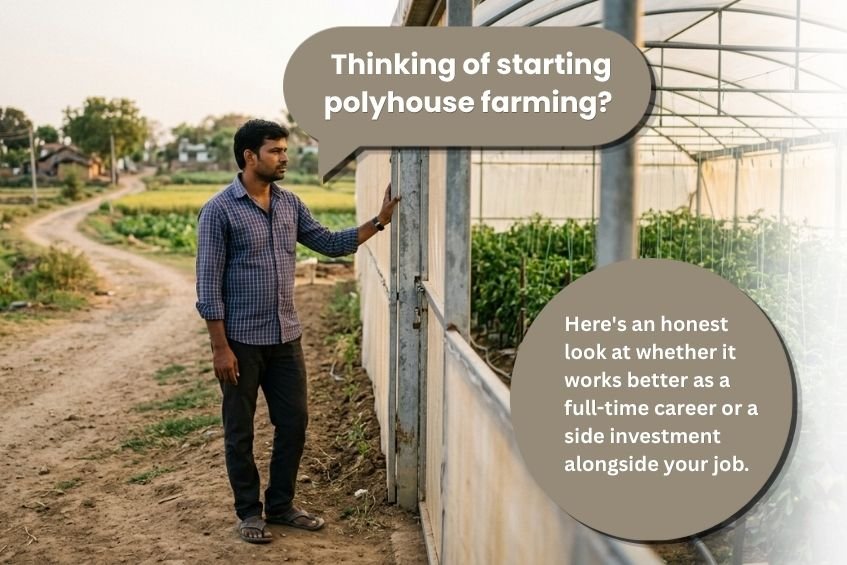
A question we get asked in almost every first meeting — and one that genuinely doesn’t have the same answer for everyone.
We sit down with a lot of people thinking about their first polyhouse, and this question comes up in some form almost every single time: “Should I quit my job for this, or just run it on the side?” It’s a fair question, and honestly, we’ve seen both approaches work — and both fail. The difference usually isn’t the crop or the structure. It’s whether the person picked the right model for their actual life circumstances. Let’s walk through how to think about it properly.
The Side-Investment Model: Lower Risk, Slower Build
A lot of our clients are salaried professionals, shop owners, or people already running another business who see polyhouse farming as a way to put land to productive use without walking away from their existing income. This model has real advantages. You’re not betting your entire livelihood on one crop cycle. You have a financial cushion if a season underperforms. And you can start smaller — a half-acre or one-acre shade net house is a completely reasonable way to test the waters before committing serious capital.
The catch is that this model demands trust in someone else to manage the day-to-day. Polyhouse crops aren’t “plant and forget” — they need daily attention to irrigation, temperature, pest monitoring, and harvesting schedules. If you’re not physically present, you need a reliable farm supervisor or worker, and that adds a recurring cost most first-time side-investors underestimate. We’ve seen absentee-owner setups do very well when there’s a good on-ground person managing things, and we’ve seen others quietly underperform for the same reason — a crop nobody’s really watching closely.
The Full-Time Model: Higher Ceiling, Higher Involvement
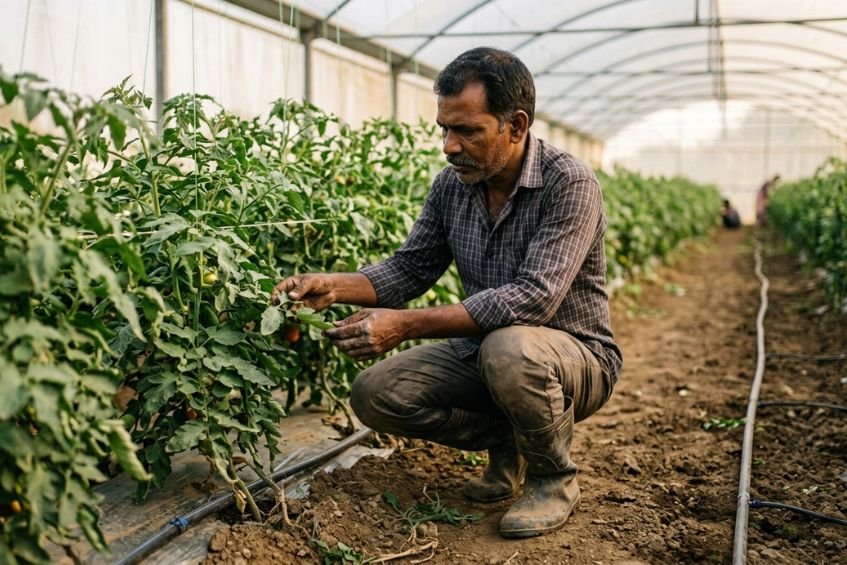
The other type of client we work with has made a deliberate decision to make this their main livelihood. Usually they’ve either grown up around farming and are modernising a family operation, or they’re stepping away from a job specifically to build something of their own. This path tends to produce stronger results over time, and it’s not hard to see why — someone present every day catches problems early, adjusts irrigation and ventilation in real time, and builds direct buyer relationships instead of relying entirely on a hired manager’s judgment.
But full-time also means full exposure. If a crop cycle underperforms because of a price crash or an unexpected pest issue, there’s no salary quietly covering the gap that month. This is exactly why the farmers who do well full-time tend to be the ones who plan their finances carefully from the start — realistic working capital, a buffer for at least one weak season, and a clear-eyed view of break-even timelines rather than best-case assumptions.
A Middle Path That Works Better Than People Expect
There’s a third option we see work quietly well, and it doesn’t get talked about much: starting as a side investment with a trusted manager, and transitioning to full-time only once the operation has proven itself over a couple of cycles. This lets you learn the business — the real rhythms of it, not the theory — while your main income is still protecting you financially. If it goes well and you enjoy it, stepping in full-time later is a far more confident decision than jumping in blind on day one.
Questions Worth Asking Yourself Before You Decide
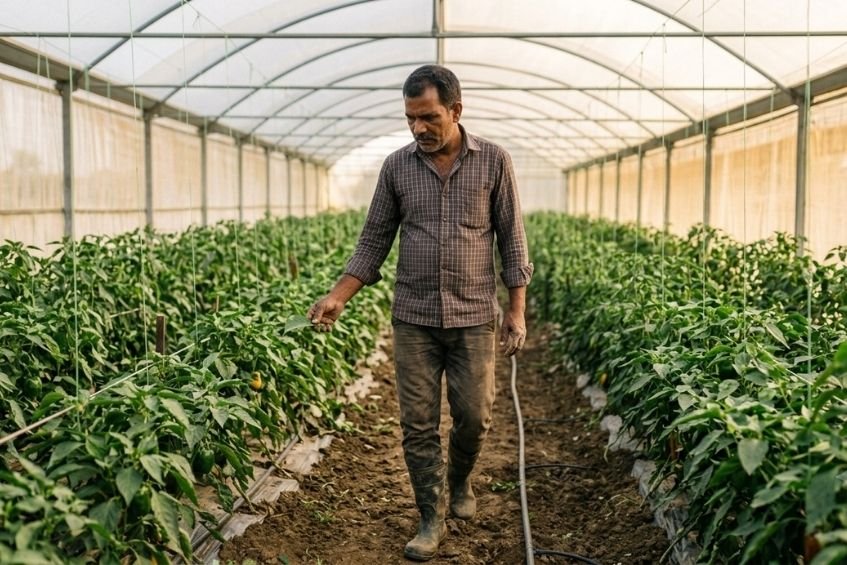
Can you genuinely visit the site multiple times a week, or will it be a monthly check-in at best? Be honest with yourself here. A side investment that gets visited once a month rarely performs as well as one visited two or three times a week, even with a hired manager in place.
Do you have someone you’d genuinely trust to run daily operations? Not just someone available — someone who’ll actually flag problems early instead of letting them slide. This single factor probably matters more than the crop you choose.
Can your household finances handle a weak first season without stress? This matters for both paths, but especially for going full-time. A side investment has your salary as a cushion; a full-time operation doesn’t.
Are you doing this because you’re drawn to farming, or purely chasing the profit numbers you’ve read online? The people who stick with this long enough to see real returns are usually the ones who find some genuine interest in the work itself, not just the financial upside.
The Financial Side Looks Different for Each Path
Whichever route you’re leaning toward, don’t skip the groundwork on financing. Subsidy support under government schemes can meaningfully reduce your upfront investment either way, but the way you structure your loan and repayment plan should reflect which path you’re on — a full-time farmer relying entirely on this income needs a more conservative repayment structure than someone with a salary backing up the loan. This is exactly the kind of thing worth working through with proper project management support from the planning stage, rather than figuring it out after construction is already underway.
Our Honest Take
There’s no universally right answer here, and anyone telling you there is hasn’t actually watched enough farms play out over a few years. What we can say confidently is this: the failures we’ve seen usually come from mismatched expectations, not a bad crop or a bad structure. Someone treating a side investment like it’ll run itself, or someone going full-time without the financial cushion to survive one rough season — those are the situations that go wrong. Pick the model that honestly matches your time, your risk tolerance, and your finances, and either path can work.
Frequently Asked Questions
Can polyhouse farming realistically replace a full-time salary?
Yes, for many farmers it can — but usually not from day one. It typically takes a couple of crop cycles to build both the operational rhythm and market relationships that make the income reliable enough to depend on fully.
How much time does a side-investment polyhouse actually need from the owner?
It varies by crop and how much you trust your on-ground manager, but most owners who do this successfully visit at least once or twice a week, even if daily operations are handled by someone else.
Is it harder to get a loan for a side investment versus a full-time farming operation?
Not necessarily harder, but banks will look at your overall income and repayment capacity either way. A salaried applicant with a side investment may actually find approval smoother, since the existing income adds to repayment confidence.
What’s the biggest mistake people make when starting this as a side business?
Underestimating how much daily attention the crop needs and assuming a hired hand will manage everything without any oversight. Even a great manager benefits from regular check-ins from the owner.
This article reflects general patterns observed across different types of polyhouse farming operations. Individual circumstances vary significantly — please consult with our team for guidance specific to your land, budget, and availability.
Not sure which path fits your situation?
AgroDome can help you think through the numbers, time commitment, and financing that make sense for your specific circumstances — before you commit either way.
Get a Free Consultation