
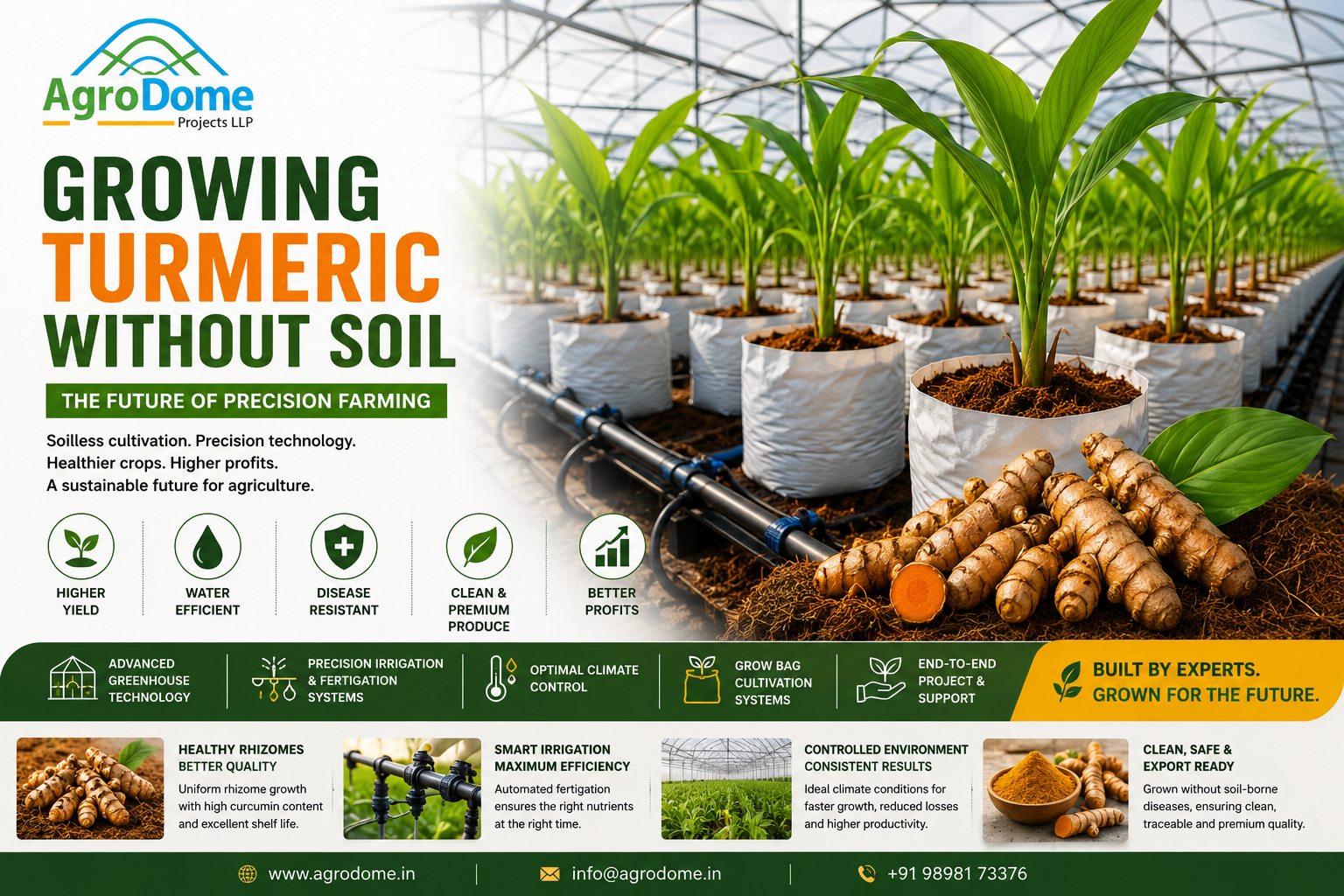
How AgroDome Projects LLP is Transforming High-Value Spice Cultivation Through Protected Farming
Introduction: Agriculture is Entering a New Era
Turmeric has been a part of Indian agriculture, medicine, and culture for centuries. From traditional farming fields to global nutraceutical industries, turmeric continues to hold enormous economic and commercial value. However, modern agriculture is evolving rapidly, and traditional cultivation methods are now facing significant challenges.
Farmers today are dealing with:
- Declining soil fertility
- Rising water scarcity
- Climate unpredictability
- Soil-borne diseases
- Labour shortages
- Market pressure for premium-quality produce
- Increasing demand for residue-free crops
At the same time, international markets are becoming more quality-conscious. Buyers now expect cleaner produce, better traceability, consistent quality, and sustainable farming practices.
This changing agricultural landscape has opened the door for a revolutionary cultivation approach — soilless turmeric farming.
At AgroDome Projects LLP, we believe the future of farming lies in precision-controlled agriculture supported by advanced greenhouse infrastructure and sustainable farming technologies.
Growing turmeric without soil is no longer a futuristic experiment. It is becoming a commercially viable farming model for progressive growers, agripreneurs, investors, exporters, and modern farming businesses.
What is Soilless Turmeric Farming?
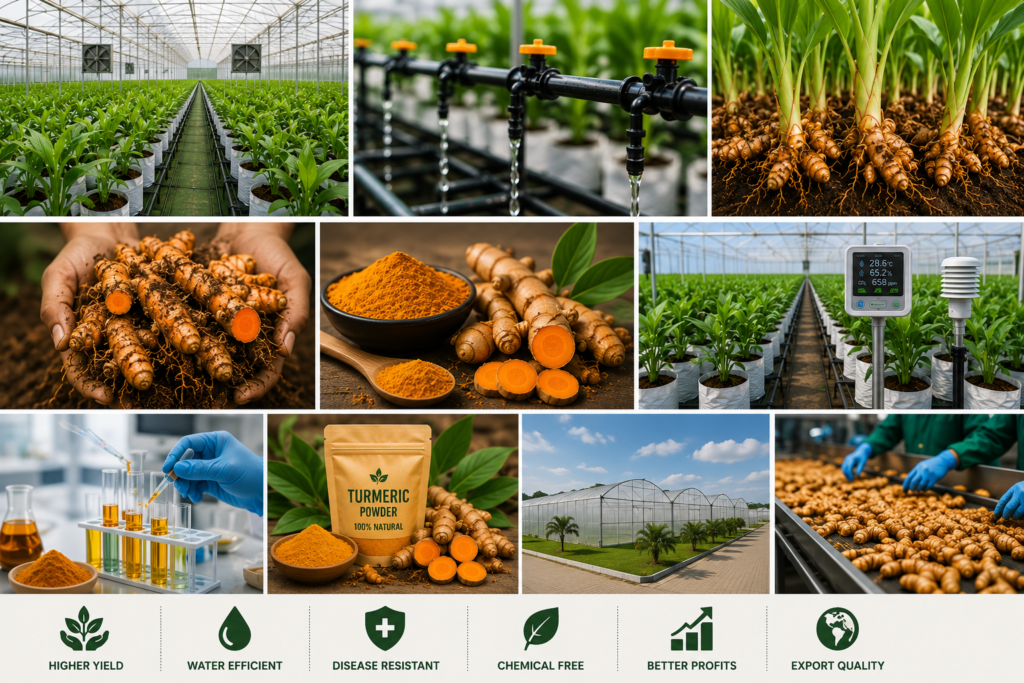
Soilless turmeric farming refers to cultivating turmeric without using conventional agricultural soil. Instead, the crop is grown using carefully designed growing media such as:
- Cocopeat
- Perlite
- Vermiculite
- Organic substrates
- Grow bag cultivation systems
These systems are generally installed inside:
- Naturally ventilated polyhouses
- Climate-controlled greenhouses
- Retractable greenhouse structures
- Precision farming environments
The crop receives nutrients directly through fertigation systems, where water-soluble nutrients are delivered in controlled quantities.
Unlike traditional farming, where crop health depends heavily on unpredictable soil and weather conditions, protected soilless farming allows growers to control:
- Irrigation
- Nutrient management
- Root-zone moisture
- Temperature
- Relative humidity
- Ventilation
- Crop hygiene
- Disease pressure
This creates a highly efficient cultivation ecosystem that supports better crop growth and improved yield quality.
Why Soilless Turmeric Farming is Gaining Attention Worldwide
Global agriculture is moving toward sustainable and precision-based cultivation systems. High-value crops are increasingly being shifted to controlled-environment farming due to better productivity and resource efficiency.
Turmeric is now joining that transition.
Modern growers are realising that traditional cultivation methods often lead to:
- Inconsistent rhizome quality
- Water wastage
- Soil contamination
- Crop diseases
- Lower market-grade yield
- Irregular harvests
Soilless cultivation helps overcome many of these limitations.
Major Advantages of Growing Turmeric Without Soil
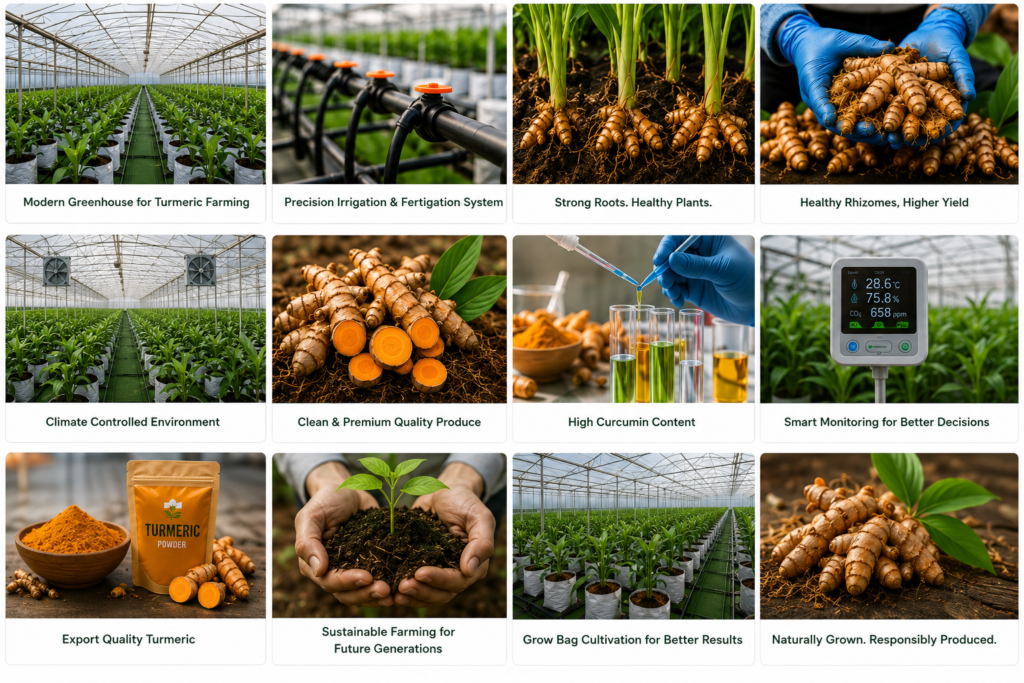
1. Better Yield Potential
When turmeric is grown in optimized environmental conditions, plants experience less stress and more uniform growth.
This can result in:
- Improved rhizome development
- Better nutrient absorption
- More consistent crop quality
- Healthier root systems
- Higher commercial-grade output
With proper infrastructure and cultivation management, growers can achieve significantly improved productivity compared to conventional farming.
2. Water-Efficient Farming
Water is becoming one of agriculture’s biggest concerns.
Traditional field farming often loses large quantities of water through:
- Runoff
- Evaporation
- Soil seepage
- Uneven irrigation distribution
Soilless farming systems use precision irrigation and fertigation techniques that deliver water directly to the root zone.
This improves:
- Water-use efficiency
- Nutrient uptake
- Irrigation accuracy
- Crop consistency
For regions facing groundwater depletion and uncertain rainfall patterns, this becomes a major advantage.
3. Reduced Soil-Borne Disease Risk
Traditional turmeric farming is vulnerable to several challenges including:
- Rhizome rot
- Fungal infections
- Soil contamination
- Nematodes
- Root-zone diseases
Soilless systems reduce dependence on agricultural soil and create cleaner root environments.
By using sterilized substrates and controlled irrigation systems, growers can significantly improve crop hygiene and reduce disease pressure.
4. Cleaner and Export-Oriented Produce
International spice markets increasingly demand:
- Residue-free produce
- Cleaner harvests
- Traceable farming systems
- Consistent quality standards
Protected cultivation enables growers to produce turmeric with improved cleanliness and better visual quality.
This creates opportunities in:
- Premium spice markets
- Nutraceutical industries
- Curcumin extraction businesses
- Organic farming markets
- Export-oriented agriculture
Why Protected Cultivation Matters in Turmeric Farming
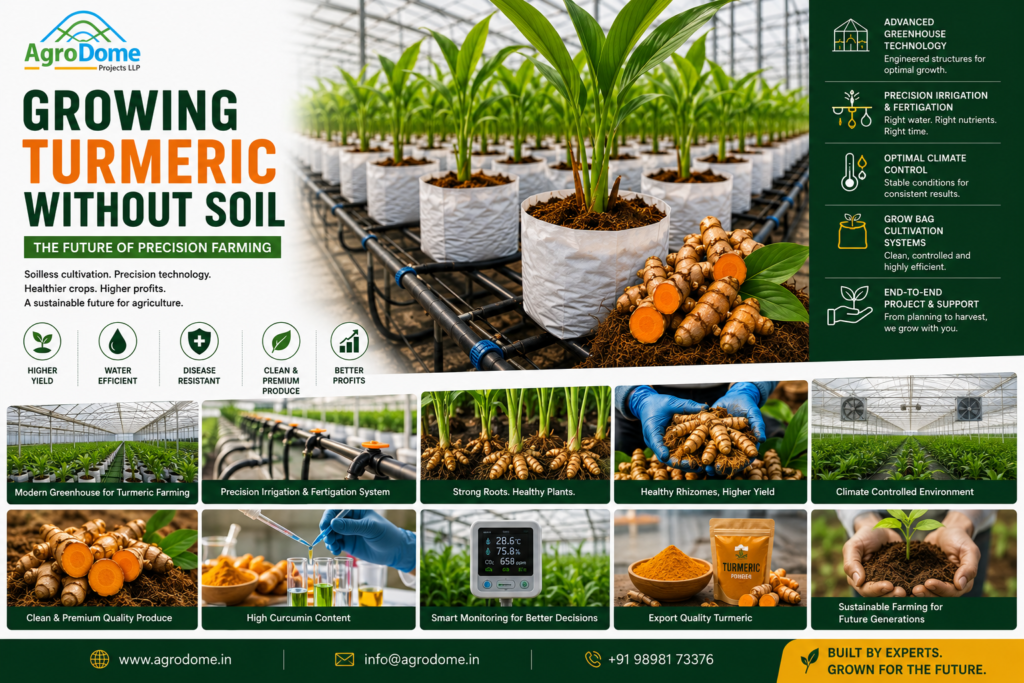
Turmeric performs best in warm and humid conditions. However, open-field farming exposes crops to:
- Excessive rainfall
- Heat stress
- Unseasonal weather
- Wind damage
- Inconsistent irrigation
- Pest and disease outbreaks
Protected cultivation creates a controlled microclimate that supports stable crop growth.
Using greenhouse infrastructure, farmers can regulate:
- Temperature
- Humidity
- Ventilation
- Irrigation schedules
- Nutrient management
- Air circulation
This creates a healthier and more predictable farming environment.
At AgroDome Projects LLP, our greenhouse engineering solutions are designed specifically for Indian climatic conditions and commercial-scale farming.
AgroDome’s Approach to Modern Turmeric Farming
At AgroDome Projects LLP, we do not simply install greenhouse structures.
We build complete protected cultivation ecosystems.
Our approach combines:
- Engineering expertise
- Agronomic planning
- Precision irrigation
- Environmental management
- Infrastructure optimization
- Long-term farming sustainability
AgroDome’s Core Protected Cultivation Solutions
- Naturally Ventilated Polyhouses– Designed for efficient airflow and economical climate management.
- Retractable Greenhouse Systems– Advanced structures that provide flexibility for varying climatic conditions.
- Precision Irrigation & Fertigation Systems– Ensuring accurate nutrient delivery and water optimization.
- Grow Bag & Substrate Farming Systems- Ideal for high-value crop cultivation including turmeric, berries, vegetables, and medicinal crops.
- Climate-Controlled Farming Infrastructure– Supporting stable production under diverse environmental conditions.
- Commercial Turnkey Farming Projects– End-to-end project execution for investors, agribusinesses, and progressive farmers.
Why Cocopeat is Emerging as the Preferred Growing Medium ?
The choice of growing substrate is extremely important in soilless farming.
Cocopeat has become one of the most preferred media because it offers:
- Excellent water retention
- Proper root aeration
- Stable moisture levels
- Reduced compaction
- Good drainage balance
- Better root-zone development
For turmeric cultivation, healthy root environments are critical for strong rhizome formation.
At AgroDome, substrate recommendations are customized based on:
- Regional climate
- Water quality
- Crop variety
- Infrastructure design
- Commercial objectives
This ensures growers receive solutions that are practical and commercially sustainable.
Precision Farming Technologies Driving the Future
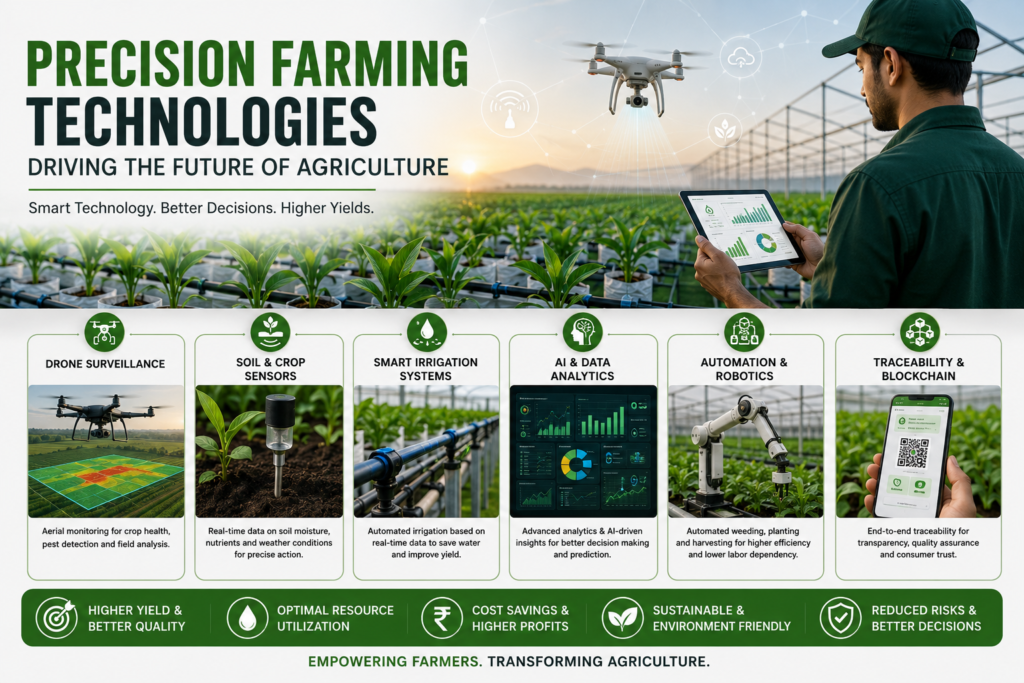
Modern agriculture is becoming increasingly data-driven.
Protected cultivation systems now integrate technologies such as:
- Automated irrigation systems
- Climate monitoring sensors
- Humidity control systems
- Fertigation automation
- Smart environmental controls
- Remote monitoring systems
These technologies help growers:
- Reduce resource wastage
- Improve crop consistency
- Increase operational efficiency
- Monitor plant performance
- Improve decision-making
At AgroDome, we believe technology-enabled farming will play a major role in shaping India’s agricultural future.
Economic Advantages of Soilless Turmeric Cultivation
Although protected cultivation requires initial infrastructure investment, the long
- Higher Market-Grade Production- Better crop consistency improves commercial value.
- Better Resource Efficiency- Controlled irrigation and nutrient delivery reduce wastage.
- Lower Crop Losses- Protected farming reduces environmental and disease-related risks.
- Cleaner Produce- Improved harvest quality supports premium market positioning.
- Improved Export Opportunities- High-quality produce can access better-value markets.
- Year-Round Farming Planning- Controlled environments improve production predictability.
- Long-Term Farming Sustainability- Efficient farming systems support scalable agricultural operations.
Soil vs Soilless Turmeric Farming: A Comparative Perspective
| Parameter | Traditional Soil Farming | Soilless Protected Farming |
|---|---|---|
| Water Usage | Higher | Optimized |
| Disease Risk | High | Lower |
| Climate Dependency | High | Controlled |
| Yield Uniformity | Variable | More Consistent |
| Root-Zone Control | Limited | Precise |
| Crop Cleanliness | Moderate | Better |
| Infrastructure Requirement | Low | Moderate to High |
| Export Potential | Moderate | Higher |
| Nutrient Precision | Limited | Advanced |
| Scalability | Moderate | High |
Common Mistakes Farmers Make While Entering Soilless Farming
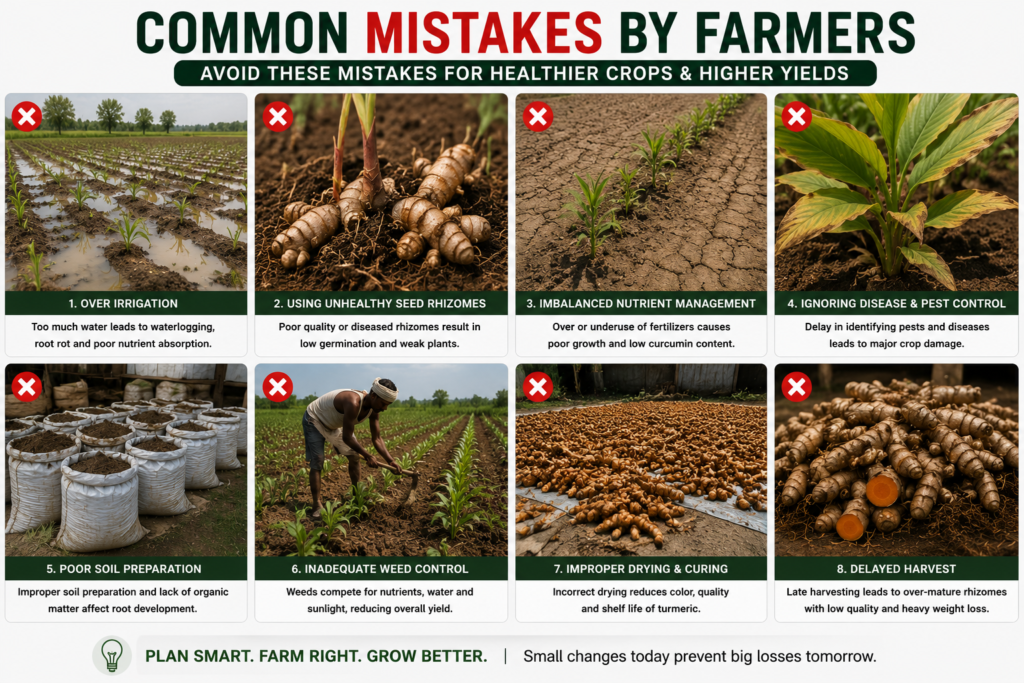
Many growers become interested in hydroponics and protected farming after seeing high-yield success stories online. However, successful implementation requires proper planning.
Ignoring Climate Suitability
Not every structure design works for every region.
Poor Irrigation Planning
Incorrect fertigation design can affect crop performance.
Low-Quality Infrastructure
Weak structures increase long-term operational risks.
Lack of Technical Monitoring
Precision farming requires regular monitoring and management.
Incorrect Crop Selection
The farming model must align with market demand and climatic suitability.
Underestimating Operational Management
Protected cultivation requires disciplined farm management practices.
At AgroDome, our focus is on practical and sustainable implementation rather than unrealistic promises.
Is Soilless Turmeric Farming Suitable for India?
Absolutely, India has enormous potential for protected cultivation because:
- The domestic turmeric market is massive
- Export demand continues to rise
- Climate variability is increasing
- Water-efficient farming is becoming essential
- Premium farming opportunities are expanding
Regions with extreme weather fluctuations can especially benefit from controlled cultivation environments.
As Indian agriculture moves toward modernization, protected farming systems are expected to play a major role in high-value crop production.
The Future of High-Value Agriculture in India
The future belongs to growers who embrace:
- Precision agriculture
- Climate-smart farming
- Sustainable cultivation
- Water-efficient systems
- High-value crop diversification
- Controlled environment agriculture
Turmeric is no longer just a traditional field crop.
It is becoming a premium commercial opportunity powered by greenhouse technology, scientific cultivation practices, and infrastructure innovation.
At AgroDome Projects LLP, we are committed to helping progressive farmers and agribusinesses transition toward future-ready farming systems.
Why AgroDome Projects LLP?
AgroDome Projects LLP is dedicated to delivering advanced protected cultivation solutions that combine:
- Innovation
- Engineering precision
- Agronomic expertise
- Sustainable farming practices
- Commercial viability
We provide:
- Turnkey greenhouse solutions
- Polyhouse infrastructure
- Precision irrigation systems
- Climate-controlled cultivation systems
- Retractable greenhouse projects
- High-value crop farming infrastructure
- Technical farming support
Our mission is simple:
To help modern agriculture become more productive, sustainable, and future-ready.
AgroDome Case Study Perspective: What Modern Farmers Are Looking For
Across India, progressive growers are increasingly shifting toward protected cultivation because they are seeking:
- Better profitability per acre
- Water-efficient farming models
- Export-oriented produce quality
- Controlled cultivation systems
- Reduced climate dependency
- Sustainable farming practices
At AgroDome Projects LLP, we are witnessing growing interest from:
- Agripreneurs
- Institutional investors
- Progressive farmers
- Export businesses
- Young entrepreneurs entering agriculture
Particularly in high-value crops, growers are now focusing less on conventional volume farming and more on precision-driven quality farming.
This transition is creating strong opportunities for advanced cultivation systems like:
- Greenhouse turmeric farming
- Hydroponic berry cultivation
- Protected vegetable farming
- Grow bag farming systems
- Controlled-environment agriculture
ROI Potential & Commercial Viability
One of the biggest questions growers ask is:
“Can protected turmeric cultivation become commercially profitable?”
The answer depends on several factors including:
- Infrastructure quality
- Climate suitability
- Farm management
- Market access
- Crop planning
- Technical execution
However, when properly implemented, soilless turmeric farming can create advantages such as:
Better Crop Uniformity
Consistent crop quality supports stronger market positioning.
Premium Market Opportunities
Cleaner produce can access high-value domestic and export markets.
Efficient Resource Utilization
Precision irrigation and nutrient management improve operational efficiency.
Long-Term Farm Scalability
Protected cultivation systems support organized commercial farming.
Diversification Opportunities
The same infrastructure can often support multiple high-value crops.
At AgroDome, we strongly emphasize realistic planning and long-term sustainability over exaggerated yield claims.
Why AgroDome’s Greenhouse Philosophy is Different
Many greenhouse providers focus only on structure installation.
At AgroDome Projects LLP, our approach is fundamentally different.
We believe successful farming infrastructure must integrate:
- Engineering precision
- Agronomic understanding
- Climate adaptability
- Commercial practicality
- Long-term operational sustainability
Every protected cultivation project requires customization.
A greenhouse suitable for one climatic zone may not perform efficiently in another.
That is why our planning process considers:
- Regional climate patterns
- Crop requirements
- Ventilation optimization
- Structural durability
- Irrigation efficiency
- Future scalability
- Operational practicality
This integrated approach helps create farming systems that are both productive and sustainable.
The Role of Greenhouse Infrastructure in India’s Agricultural Future
Indian agriculture is entering a transformation phase.
With shrinking land resources and increasing pressure on productivity, future farming will increasingly depend on:
- Protected cultivation
- Precision irrigation
- Automation
- Climate-smart agriculture
- Sustainable resource management
- High-value crop diversification
Greenhouse and polyhouse farming are no longer niche concepts.
They are becoming critical infrastructure for the future of commercial agriculture.
At AgroDome Projects LLP, our vision is to contribute toward building future-ready agricultural ecosystems that empower farmers with modern, scalable, and sustainable cultivation solutions.
Frequently Asked Questions About Soilless Turmeric Farming
Can turmeric really grow without soil?
Yes. Turmeric can be cultivated successfully using soilless growing media such as cocopeat and grow bag systems inside protected farming environments.
Is hydroponic turmeric farming commercially viable?
Commercial viability depends on infrastructure quality, operational management, crop planning, and market access. Properly designed systems can create strong long-term opportunities.
Which structure is best for turmeric cultivation?
Depending on climate and commercial goals, growers may choose naturally ventilated polyhouses, climate-controlled greenhouses, or retractable structures.
Is soilless turmeric farming suitable for Indian climates?
Yes. With proper greenhouse engineering and irrigation planning, controlled cultivation can perform efficiently across many Indian regions.
What are the major advantages of protected turmeric cultivation?
Key advantages include:
- Better environmental control
- Improved water efficiency
- Reduced disease pressure
- Cleaner produce
- Better crop consistency
- Premium market opportunities
Why is cocopeat commonly used?
Cocopeat provides balanced water retention and root aeration, making it suitable for controlled-environment cultivation systems.
Final Thoughts
Growing turmeric without soil represents far more than a farming trend.
It reflects a larger transformation happening across agriculture — a shift toward smarter, cleaner, and more resource-efficient farming systems.
As demand for premium-quality produce rises globally, growers who adopt precision farming and protected cultivation technologies will be better positioned for long-term success.
The future of agriculture will not depend only on how much land we cultivate.
It will depend on how intelligently we cultivate it.
And that future has already begun.
Connect With AgroDome Projects LLP
Website: https://www.agrodome.in
Email: info@agrodome.in
Phone: +91 98981 73376