
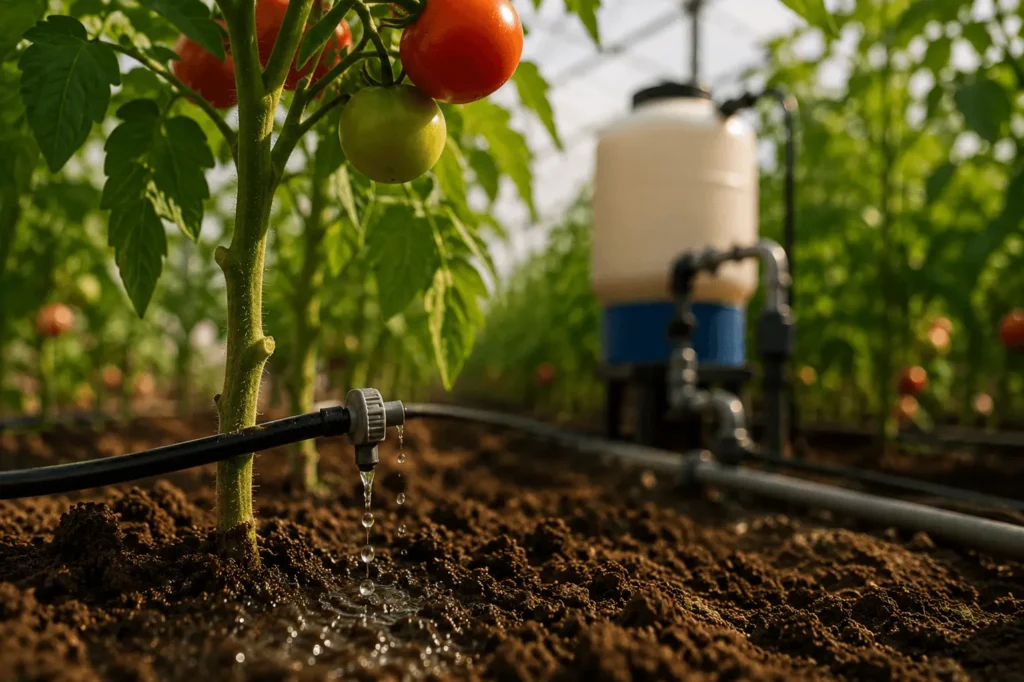
For any polyhouse farmer in India, two things directly control your crop’s performance and your input costs — how water reaches your plants and how nutrients are delivered. Drip irrigation combined with fertigation is the most efficient answer to both. When set up correctly inside a polyhouse, this system can cut water use by up to 60%, reduce fertilizer waste, and significantly improve crop yields — all at the same time.
This guide covers everything you need to know to plan, install, and operate a drip-fertigation system inside your polyhouse or greenhouse — from understanding the basics to managing it season after season.
What Is Drip Irrigation & Fertigation?
Drip irrigation is a method of delivering water slowly and directly to the root zone of each plant through a network of pipes, tubes, and emitters. Unlike flood or sprinkler irrigation, water never touches the leaves or bare soil unnecessarily — it goes exactly where it’s needed.
Fertigation is the practice of dissolving water-soluble fertilizers into the irrigation water and delivering them through the same drip system. Instead of broadcasting fertilizer on the soil surface — where much of it evaporates, leaches, or gets wasted — fertigation places nutrients directly at the root zone at precisely the right time.
Inside a polyhouse, where every input is controlled and crops are grown at higher intensity, this combination is not just beneficial — it is essential.
Why Drip Fertigation Is Ideal for Polyhouse Farming
Polyhouses create a controlled growing environment, but that control is only valuable when your water and nutrition delivery matches it. Here is why drip fertigation fits perfectly:
- No rainwater inside the structure — the polyhouse roof blocks natural rainfall, so 100% of water must come from your irrigation system. Drip ensures consistent and reliable supply.
- High-density planting — polyhouses often have higher plant populations per unit area, making uniform water and nutrient distribution across every plant critical.
- Disease prevention — wet foliage encourages fungal diseases like powdery mildew and botrytis. Drip keeps leaves dry while the root zone stays moist.
- Precise nutrition timing — fertigation allows you to match nutrient supply with each crop growth stage, from transplanting to flowering to fruiting.
- Reduced labour — automated drip-fertigation systems eliminate manual watering and fertilizer application entirely, freeing up farm labour for other tasks.
- Water scarcity — most polyhouse zones in India face seasonal water stress. Drip typically uses 40–60% less water than surface irrigation methods.
Key Components of a Drip-Fertigation System
A properly designed drip-fertigation system for a polyhouse has several interconnected components. Understanding each one helps you make better decisions during setup and troubleshooting.
1. Water Source & Storage
Your system begins at the water source — borewell, canal, farm pond, or municipal supply. Water is typically stored in an overhead or ground-level tank. For a 1,000 sq. metre polyhouse, a storage capacity of 5,000 to 10,000 litres is generally sufficient for one full irrigation cycle. Overhead tanks create natural pressure for smaller setups; larger operations use electric pumps with pressure regulators.
2. Filtration Unit
Filtration is the most critical component for system longevity. Even slightly turbid water can clog drip emitters within days. A standard setup includes a sand/media filter (removes particles and algae), followed by a disc or screen filter (removes fine particles). For fertigation, a secondary filter after the fertilizer injection point is also recommended to catch undissolved particles before they enter the laterals.
3. Fertilizer Injection System
This is what converts a drip system into a fertigation system. There are three common types used in Indian polyhouses:
- Venturi Injector — the most affordable option (₹1,500–₹5,000). Uses pressure differential to draw fertilizer solution into the mainline. No electricity needed. Suitable for small to medium polyhouses.
- Fertilizer Tank (Bypass Tank) — a simple pressure tank where irrigation water passes through a fertilizer-filled tank, absorbing dissolved nutrients. Low cost but difficult to control concentration precisely.
- EC/pH-based Dosing Pump — an automated system with sensors that monitor electrical conductivity and pH in real time and inject precise fertilizer doses. Best for commercial polyhouse operations growing high-value crops like tomato, capsicum, or cucumber.
4. Mainline, Submain & Lateral Pipes
Water flows from the filtration unit through a mainline (typically 63 mm or 75 mm HDPE pipe) into submain pipes (32–50 mm) that run along the length of each bay. From the submains, lateral pipes (12–16 mm) branch out along each crop row. Drip emitters or inline drippers are fitted on the laterals at plant-to-plant spacing.
5. Drip Emitters & Drippers
Emitters are available in several flow rates — typically 2 LPH, 4 LPH, or 8 LPH (litres per hour). For polyhouse crops, pressure-compensating (PC) drippers are strongly recommended. They deliver a consistent flow rate regardless of pressure variation across the length of a long lateral, ensuring uniform water delivery to all plants whether they are near the mainline or far from it.
6. Automation & Timer Controls
Even a basic timer connected to a solenoid valve can automate irrigation scheduling. Advanced setups use soil moisture sensors or tensiometers that trigger irrigation only when the soil reaches a defined moisture deficit. For commercial polyhouses, fully automated controllers connected to fertigation pumps and EC/pH meters provide complete hands-free operation.
How to Design Your Drip System for a Polyhouse
Good design prevents the most common problems — uneven water distribution, emitter clogging, and fertilizer burn. Follow these steps:
Step 1: Know Your Crop & Spacing
The plant spacing determines where laterals are placed and how many emitters are needed per plant. For example, tomato planted at 60 cm × 120 cm spacing in a 1,000 sq. metre polyhouse would have roughly 1,380 plants, each needing its own dripper. Map this out before ordering materials.
Step 2: Calculate Daily Water Requirement
Water requirement varies by crop, growth stage, and season. A general reference for polyhouse crops in India:
| Crop | Peak Water Need (litres/plant/day) | Season |
|---|---|---|
| Tomato | 1.5 – 2.5 litres | Summer (fruiting stage) |
| Cucumber | 2.0 – 3.0 litres | Fruiting stage |
| Capsicum | 1.0 – 1.8 litres | Fruiting stage |
| Rose (cut flower) | 0.5 – 1.0 litre | Year-round |
| Gerbera | 0.4 – 0.8 litre | Year-round |
Step 3: Choose Dripper Flow Rate & Irrigation Duration
Once you know the daily water requirement per plant, choose a dripper flow rate (2 LPH or 4 LPH) and calculate how many hours per day the system should run. For example, if a tomato plant needs 2 litres per day and your dripper flows at 2 LPH, you need 1 hour of irrigation per day — split into 2–3 shorter cycles to avoid waterlogging.
Step 4: Lay Out the Pipe Network
Place the mainline along the central spine of the polyhouse. Run submains perpendicular to the mainline at the start of each bay. Lay laterals along each plant row. Always use end caps at the far end of each lateral, and install flush valves for periodic cleaning. Keep lateral length under 60–80 metres to maintain uniform pressure.
Fertigation Scheduling by Crop Growth Stage
Fertigation is most effective when nutrients are matched to what the crop actually needs at each stage of its life. Here is a general framework for vegetable crops like tomato and capsicum:
| Growth Stage | Duration | Key Nutrients | EC Target (mS/cm) |
|---|---|---|---|
| Transplanting / Establishment | Week 1–2 | Phosphorus, Calcium | 1.5 – 2.0 |
| Vegetative Growth | Week 3–5 | Nitrogen, Potassium, Magnesium | 2.0 – 2.5 |
| Flowering | Week 6–8 | Phosphorus, Boron, Zinc | 2.5 – 3.0 |
| Fruit Development | Week 9–14 | Potassium, Calcium, Nitrogen | 2.5 – 3.5 |
| Ripening / Harvest | Week 15+ | Potassium (reduce Nitrogen) | 3.0 – 4.0 |
Always monitor EC (electrical conductivity) and pH of your irrigation water. For most polyhouse crops, the ideal pH range is 5.8 to 6.5. Water outside this range locks up nutrients even when they are present in adequate quantities.
Water-Soluble Fertilizers Commonly Used in Fertigation
Only fully water-soluble fertilizers should be used in a fertigation system. Granular or slow-release fertilizers will clog emitters. Commonly used options in Indian polyhouses include:
- 19:19:19 (NPK) — a balanced starter fertilizer used during the establishment phase.
- 12:61:00 (Mono Ammonium Phosphate) — high phosphorus for root development and flowering.
- 00:52:34 (Mono Potassium Phosphate) — phosphorus and potassium during flowering and fruit set.
- 13:00:45 (Potassium Nitrate) — high potassium during fruiting and ripening for improved fruit quality and colour.
- Calcium Nitrate — prevents calcium deficiency disorders like blossom end rot in tomato and tip burn in lettuce.
- Magnesium Sulphate (Epsom Salt) — prevents interveinal chlorosis; important in high-yield polyhouse crops.
- Micronutrient Mix (Chelated) — zinc, boron, iron, manganese; applied at low doses during vegetative and flowering stages.
Important: Never mix Calcium Nitrate and Sulphate-based fertilizers in the same tank — they react and precipitate, clogging your system. Always dissolve them in separate stock tanks (Tank A and Tank B) and inject them independently.
Common Mistakes to Avoid
- Skipping filtration — even clean-looking borewell water can contain iron, sand, or biological matter that clogs drippers within weeks.
- Ignoring EC and pH — many farmers fertilize by dose alone without measuring EC. This leads to either nutrient deficiency or fertilizer burn.
- Mixing incompatible fertilizers — always check fertilizer compatibility before mixing. Calcium and sulphate compounds must never share a tank.
- Long lateral runs without pressure compensation — plants at the far end of long laterals receive significantly less water than those near the inlet without PC drippers.
- Skipping flushing cycles — laterals and emitters should be flushed with plain water at the end of every fertigation cycle to prevent salt and fertilizer residue build-up.
- Watering at the wrong time — avoid irrigating late evening inside a polyhouse. Wet root zones overnight in humid conditions encourage fungal root diseases.
- Using non-WSF fertilizers — granular urea, DAP, or complex fertilizers are not suitable for fertigation and will damage emitters and pipes.
System Maintenance Schedule
A well-maintained drip system should last 8–12 years. Regular maintenance prevents 90% of system failures.
| Frequency | Task |
|---|---|
| Daily | Check pressure gauge; visually inspect laterals for leaks or blocked emitters; verify EC and pH of fertigation solution |
| Weekly | Flush all laterals from end caps; backwash sand filter; clean disc/screen filter cartridge |
| Monthly | Acid flush entire system (dilute phosphoric or nitric acid) to dissolve mineral deposits; inspect all joints and grommet connections |
| End of Season | Full system flush; chlorine shock treatment (2–5 ppm chlorine) to kill algae and bacteria; inspect and replace any damaged laterals or emitters; store stock tanks cleaned and dry |
Subsidy Support for Drip Irrigation in India
The Indian government actively supports drip irrigation adoption through two major schemes:
- PMKSY – Pradhan Mantri Krishi Sinchayee Yojana — offers 45% to 55% subsidy on drip irrigation systems for small and marginal farmers, with higher support for SC/ST farmers.
- NHM – National Horticulture Mission — provides additional support for polyhouse drip systems when combined with protected structure installation. The drip system is often subsidised as part of the integrated polyhouse project cost.
Subsidy rates vary by state. States like Gujarat, Maharashtra, Rajasthan, and Karnataka have historically offered among the highest drip irrigation subsidies in the country. Contact your district horticulture officer or apply through the Hortnet portal for your state to check current eligibility.
Final Thoughts
Drip irrigation and fertigation are not luxury additions to a polyhouse — they are the foundation of efficient, profitable protected farming. A well-designed and well-maintained system pays for itself within the first two crop cycles through water savings, reduced fertilizer waste, and higher crop quality.
The key is in the details: proper filtration, pressure-compensating emitters, stage-wise nutrition planning, and regular maintenance. Get these right, and your polyhouse becomes one of the most productive pieces of land in your district.
At AgroDome Projects LLP, our agronomy and project management teams help polyhouse farmers design complete drip-fertigation systems from scratch — tailored to your crop, your soil, your water source, and your budget. Whether you are setting up your first polyhouse or upgrading an existing system, we are here to help you get it right.
Need Help Setting Up Drip Fertigation in Your Polyhouse?
Our team at AgroDome Projects LLP provides end-to-end drip-fertigation design, installation, and agronomy support for polyhouse farmers across India.