
Agriculture is no longer just about hard work—it is about smart decisions. Agriculture today demands more than sweat—it’s about strategic mastery over nature’s whims. In India, where erratic monsoons, scorching heat, and pest surges threaten every harvest, smart farmers are ditching open fields for protected tunnels. These innovative structures—polytunnels or high tunnels—deliver unrivalled yield boosts, precise climate mastery, and rock-solid profitability, turning risks into reliable revenue.
Across India, unpredictable rainfall, rising temperatures, pest pressure, and fluctuating market prices are reshaping farming economics. Traditional open-field cultivation is increasingly exposed to climate risks that directly impact yield and profitability. In this changing landscape, a new category of growers is emerging—smart farmers who prioritize control, consistency, and calculated investment.
And their choice is clear: Protected Tunnel Farming.
But why are progressive farmers switching to protected tunnels? What makes this farming model more resilient, profitable, and future-ready?
Let’s break it down.
Rising Risks in Open-Field Farming:
Traditional farming hangs in the balance of unpredictable weather, from hail smashing tomatoes to droughts stunting growth. Sudden rains ruin flowering crops, extreme heat cuts fruit set, and winds batter plants, slashing yields by 30-50% in bad years. Pests thrive in flux, water wastes away, and market prices swing wildly.
Smart farmers see the fix: control your microclimate. Protected tunnels, covered in UV-stabilised plastic, shield crops while optimizing every growth factor. This proactive shift from reactive toil to engineered success is reshaping Indian agriculture. Open-field farming has always depended on natural weather cycles. Today, those cycles are no longer predictable.
- Sudden unseasonal rainfall damages flowering crops.
- Extreme heat reduces fruit setting.
- Heavy winds physically damage plants.
- Pest infestations rise with climate fluctuations.
- Water management becomes inconsistent.
Each of these factors directly affects yield, quality, and market price realization.
Smart farmers understand one simple truth:
If you cannot control the weather, you must control the environment.
This is where protected tunnels change the game.
What Is Protected Tunnel Farming?
Protected tunnels (also known as poly tunnels or low/high tunnels) are engineered agricultural structures covered with UV-stabilised film that creates a controlled microclimate for crops.
This shift from reactive farming to proactive farming is what defines smart agriculture today. These affordable structures create a tailored growing environment with rain barriers, ventilation flaps, and light diffusion. Unlike greenhouses, tunnels cost less to build and suit small farms perfectly. They cut pest entry, manage moisture, and enable year-round cycles for Gujarat’s heat or Rajasthan’s chills. They provide:
- Protection from heavy rain and hail
- Regulated sunlight exposure
- Controlled ventilation
- Reduced pest entry
- Better moisture management
Unlike traditional open farming, tunnel cultivation allows farmers to manage growing conditions instead of reacting to weather damage. This shift from reactive farming to proactive farming is what defines smart agriculture today.
1️⃣ Higher Yield Per Acre: The Productivity Advantage
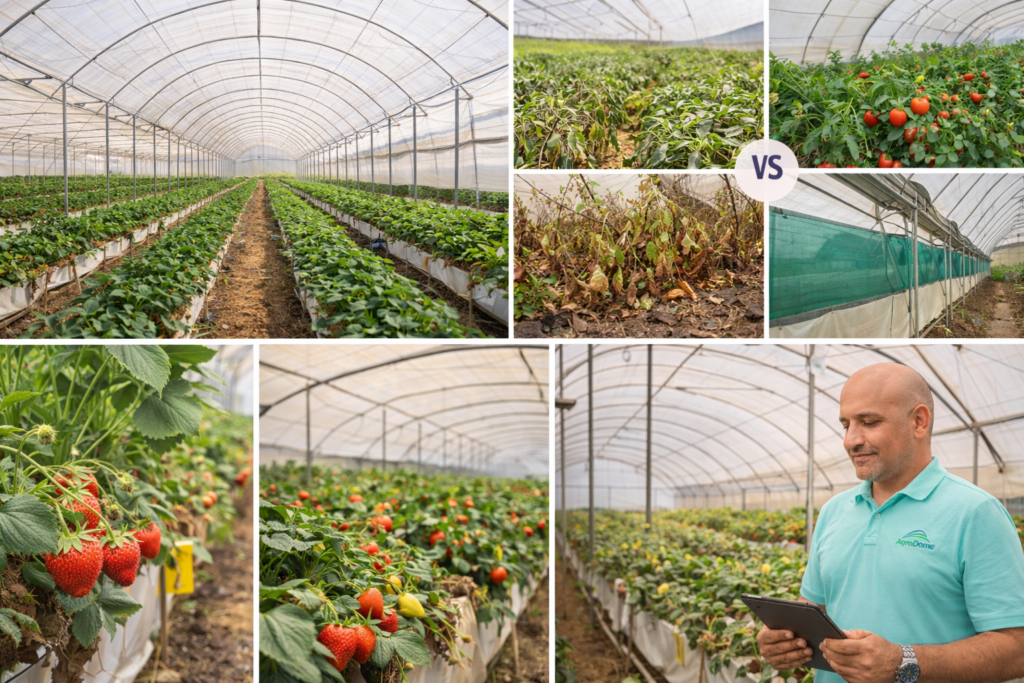
Stability equals surplus. Inside tunnels, reduced stress means fewer flower drops, uniform fruits, and extended harvests—doubling or tripling output for strawberries, cucumbers, capsicum, and cherry tomatoes. Plants channel energy into growth, not survival, yielding premium-grade produce that markets crave.
High-value exotics shine brightest, with off-season planting fetching 2-3x prices. One acre under tunnels can match three in open fields, directly pumping up profits. Yield is the backbone of farm profitability.
Under protected tunnels:
- Crops experience reduced stress.
- Flower drop decreases.
- Fruit uniformity improves.
- Crop cycle extends.
- Harvesting window increases.
Because the environment is stable, plant growth becomes consistent. This directly increases per-square-meter output.
For high-value crops like:
- Strawberry
- Cucumber
- Capsicum
- Cherry Tomato
- Exotic Vegetables
Tunnel farming can significantly outperform open-field cultivation.
Smart farmers are not just growing crops—they are optimising output per acre.
2️⃣ Climate Control: The Power of a Managed Microclimate
Tunnels tame temperature swings, block excess rain, and filter harsh sun for balanced light. Roll-up sides and vents ensure airflow, preventing overheating or humidity traps. Roots strengthen, pollination improves, and mortality plummets—perfect for India’s diverse zones.
At AgroDome Projects LLP, tunnels feature region-tuned designs: Gujarat-ready ventilation and windproof frames. It’s not coverage; it’s climate engineering for peak performance.One of the strongest reasons farmers switch to protected tunnels is climate control.
Inside a well-designed tunnel structure:
- Temperature fluctuation reduces.
- Wind impact is minimized.
- Excess rainfall is prevented.
- Light distribution becomes more balanced.
This creates a stable, growing ecosystem.
A stable microclimate results in:
- Strong root development
- Better pollination
- Improved fruit setting
- Lower plant mortality
| Feature | Open Field | Protected Tunnels |
|---|---|---|
| Yield | Seasonal, variable | 2-4x higher, consistent |
| Temperature Control | Extreme swings | Stable microclimate |
| Season Length | 3-4 months | Year-round |
| Water Use | High loss | 40-70% efficient |
| Pest Damage | Frequent | Minimal |
In simple words, less stress on crops means better performance.
At AgroDome Projects LLP, structures are engineered keeping Indian agro-climatic zones in mind—ensuring airflow design, ventilation positioning, and structural stability align with regional farming conditions.
Because tunnel farming is not just about covering crops—it is about engineering the right environment.
3️⃣ Improved Crop Quality = Better Market Price
Modern markets reward quality, not quantity alone. Markets pay for perfection: uniform size, vibrant color, and spotless skins. Tunnels minimize dust, rain scars, and bugs, delivering export-ready crops. Retailers and exporters line up, boosting prices 20-50%. Build lasting buyer ties—quality is your edge.
Retail chains, exporters, and organized buyers demand:
- Uniform size
- Better color
- Clean surface finish
- Minimal pest damage
Protected tunnel farming enhances fruit aesthetics and reduces direct exposure to dust, rain damage, and pest infestation.
The result?
- Premium grading
- Higher price realization
- Stronger buyer relationships
Smart farmers know that better quality means better negotiation power in the market.
4️⃣ Extended Production Season = More Selling Days
Open-field crops are season-bound. Start early, harvest late, and grow off-season. When open-market supply dips, tunnel farmers flood premium slots at peak prices. More selling days mean multiplied income, outpacing weather-bound rivals.
Tunnel farming extends production cycles by:
- Starting crops earlier than open farms
- Protecting late-season harvest
- Allowing off-season production
This creates a powerful advantage:
When supply in the open market reduces, tunnel farmers are still harvesting.
Lower market supply + continued production = better prices.
That is strategic farming.
5️⃣ Reduced Risk = Stable Long-Term Profitability
Farming success is not about one good season. It is about sustainable income. No more total losses from storms or frosts. Tunnels slash crop failure, erosion, and pest costs, stabilizing cash flow. Initial investment pays back in 1-2 years via higher yields and savings—structures last 5-10 years with minimal upkeep.
Protected tunnels reduce:
- Weather-related crop loss
- Pest-related damage
- Soil erosion due to heavy rainfall
- Unexpected yield drop
When risk reduces, income stability increases.
Over time, the investment in tunnel structures translates into predictable returns.
Smart farmers think long-term. They calculate ROI not just per season, but per structure lifespan.
6️⃣ Better Water Efficiency & Resource Optimization
Water scarcity is a growing concern. Water wins too: drip systems cut usage 50%, fertigation maximizes nutrients. Efficient inputs equal leaner costs and fatter margin
Tunnel farming allows:
- Efficient drip irrigation
- Reduced water evaporation
- Controlled fertigation
- Minimal nutrient runoff
This leads to:
- Lower input cost
- Higher nutrient efficiency
- Better plant absorption
Efficient farming is profitable farming.
7️⃣ Structural Engineering Matters More Than You Think
Not all tunnels endure. Weak frames collapse in winds; poor vents breed fungi. AgroDome Projects LLP delivers galvanised steel, optimised airflow, solid foundations, and zone-specific builds for India’s monsoons and heat. Durability drives decades of dividends—invest in structural science.
Poorly designed tunnels can:
- Overheat
- Collapse under wind load
- Trap humidity
- Cause fungal issues
The difference lies in engineering precision.
AgroDome Projects LLP focuses on:
- Strong galvanized structural design
- Optimized ventilation placement
- Proper foundation work
- Region-specific structural planning
- Long-term durability
Because protected cultivation begins with structure strength — not just plastic covering.
A smart farmer invests in crop science.
A smarter farmer invests in structural science.
The Psychological Shift: From Farmer to Agripreneur
The transition to protected tunnels is not just technical — it is mental.
Farmers adopting tunnels are:
- Thinking like entrepreneurs
- Planning crop cycles strategically
- Calculating cost-benefit ratios
- Targeting premium markets
- Reducing dependency on chance
They are not gambling on weather.
They are engineering outcomes.
That is the future of Indian agriculture.This switch rewires mindsets. Tunnel adopters plan cycles, crunch ROI, chase premiums, and sidestep fate. They’re entrepreneurs engineering abundance, not gamblers praying for sun.
India’s surge proves it: rising climate woes, input hikes, and quality demands favor tunnels. Yield security, consistency, and export readiness make them unstoppable.
Why the Shift Is Accelerating Across India
Across states, progressive growers are realizing:
- Climate uncertainty is increasing.
- Input costs are rising.
- Market quality standards are tightening.
- Export opportunities demand precision farming.
Protected tunnel farming addresses all these challenges.
It provides:
✔ Yield security
✔ Quality consistency
✔ Climate control
✔ Profit optimization
And most importantly — confidence.
Conclusion: Smart Farming Is Structured Farming
Agriculture is evolving.
The question is no longer:
“Should I try tunnel farming?”
The real question is:
“How long can I afford not to?”
Smart farmers switch to protected tunnels because they understand that resilience, yield, and profitability are engineered — not left to chance.
At AgroDome Projects LLP, we don’t just build structures.
We build farming environments designed for performance.
If you want higher yield, better quality, and long-term profitability, it starts with the right structure.
🌱 Control the Climate. Control the Yield.
🌐 www.agrodome.in