
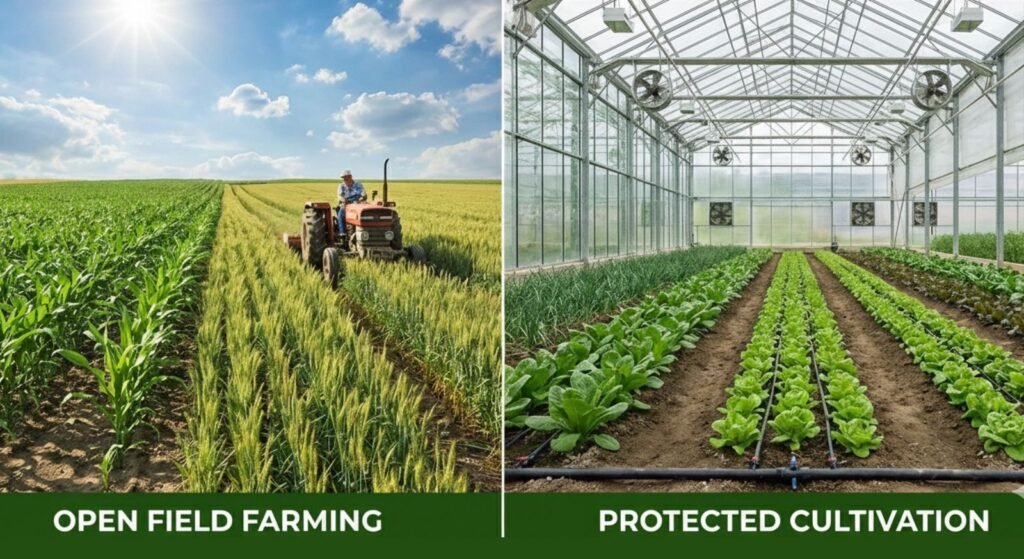
Agriculture has always depended on nature — sunlight, rainfall, temperature, and seasons. For decades, open field farming has been the backbone of food production. However, with changing climate patterns, rising input costs, and increasing demand for quality produce, farmers today are exploring protected cultivation as a smarter alternative.
But the big question remains:
Is protected cultivation really better than open field farming?
Let’s compare both systems in terms of yield, cost, risk, and profitability to help you make an informed decision.
What Is Open Field Cultivation?
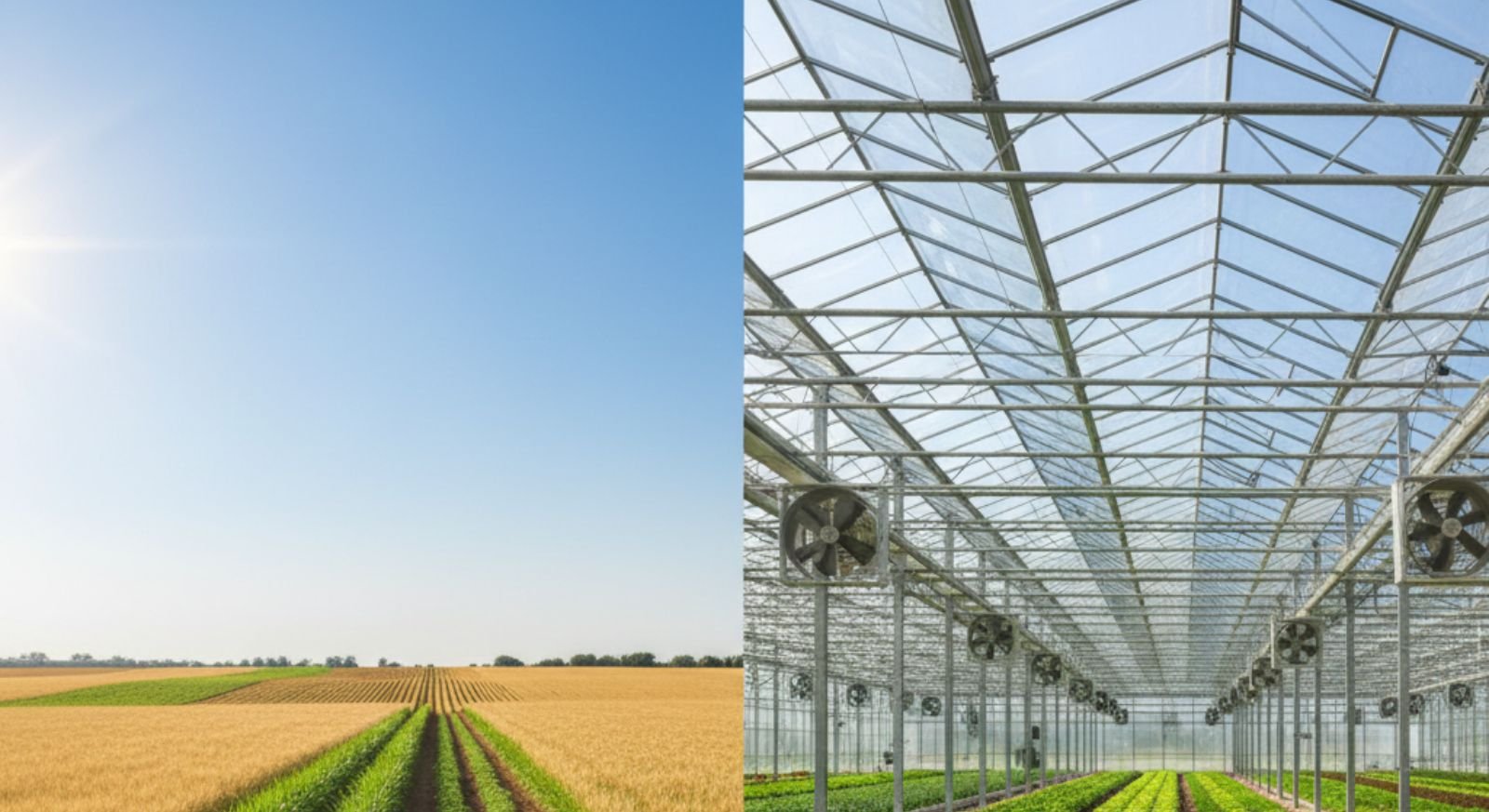
Open field cultivation refers to traditional farming practices where crops are grown directly in natural conditions without any structural protection. Crops depend entirely on weather, soil fertility, and natural rainfall or irrigation.
Advantages of Open Field Farming
- Low initial investment
- Simple farming methods
- Suitable for large land areas
- Minimal technical knowledge required
Limitations
- Highly dependent on weather
- Vulnerable to pests, diseases, and heavy rains
- Seasonal production only
- Lower yield consistency
- Unstable market prices
What Is Protected Cultivation?
Protected cultivation involves growing crops inside controlled or semi-controlled structures such as:
- Polyhouses
- Shade net houses
- Nethouses
- Retractable roof systems
- Hybrid greenhouses
These structures protect crops from adverse climatic conditions while allowing better control over temperature, humidity, light, and pests.
Advantages of Protected Cultivation
- Controlled growing environment
- Higher and consistent yields
- Better crop quality
- Reduced pest and disease pressure
- Year-round cultivation
- Higher market value produce
Yield Comparison: Open Field vs Protected Cultivation
Yield is one of the most important factors affecting farm income.
🌾 Open Field Yield
- Crop growth depends on seasonal climate
- Losses due to rain, heat stress, pests, and diseases
- Uneven growth and inconsistent quality
- Limited to one or two cropping cycles per year
🌱 Protected Cultivation Yield
- Optimized temperature and humidity
- Uniform crop growth
- Reduced crop loss
- Multiple cropping cycles possible
Example (Per Acre – Indicative):
- Tomato (Open Field): 20–25 tons
- Tomato (Polyhouse): 80–120 tons
- Capsicum (Open Field): 8–10 tons
- Capsicum (Protected): 35–50 tons
👉 Protected cultivation can increase yield by 3–5 times, depending on crop and structure type.
Cost Comparison: Initial & Operational Costs
💰 Open Field Farming Costs
- Land preparation
- Seeds, fertilizers, pesticides
- Labour and irrigation
- Low infrastructure cost
However, frequent crop failures and fluctuating prices often increase hidden losses.
🏗️ Protected Cultivation Costs
- Structure construction (polyhouse/shade net)
- Irrigation and fertigation systems
- Better quality planting material
- Skilled labour
While initial investment is higher, operational efficiency improves over time. Subsidies from government schemes such as NHB and MIDH significantly reduce capital cost.
Risk Factor Comparison
⚠️ Open Field Risks
- Heavy rainfall and flooding
- Heat waves and frost
- Pest and disease outbreaks
- Price crashes during peak season
🛡️ Protected Cultivation Risks
- Minimal climate impact
- Better pest control using insect nets
- Controlled production timing
- Stable yields
Protected cultivation allows farmers to plan production according to market demand, reducing price-related risks.
Profitability Comparison
📉 Open Field Farming
- Lower production cost
- Lower yield
- Highly fluctuating income
- Often dependent on MSP or local markets
📈 Protected Cultivation
- Higher investment but faster returns
- Premium quality produce
- Off-season production advantages
- Better access to organized markets, exports, and contracts
Average Profit Potential (Indicative):
- Open Field Crops: ₹1–2 lakh per acre per season
- Protected Cultivation: ₹6–15 lakh per acre per year (crop dependent)
👉 Most protected cultivation projects achieve ROI within 2–3 years when managed properly.
Which One Should You Choose?
| Criteria | Open Field | Protected Cultivation |
|---|---|---|
| Investment | Low | Medium to High |
| Yield | Low to Medium | High |
| Crop Quality | Average | Premium |
| Risk | High | Low |
| Season Control | No | Yes |
| Profit Potential | Limited | High |
Open Field Is Suitable If:
- You have large landholding
- You grow staple crops
- Budget is limited
- Climate is stable
Protected Cultivation Is Ideal If:
- You grow high-value crops
- You want stable income
- You aim for commercial farming
- You want long-term profitability
Role of AgroDome Projects LLP
At AgroDome Projects LLP, we help farmers transition from traditional farming to smart protected cultivation systems. From low-cost shade net houses to advanced polyhouses and retractable roof systems, our solutions are designed to suit Indian climatic conditions and farmer budgets.
We provide:
- Site assessment & feasibility study
- Structure design & execution
- Subsidy guidance
- Agronomy & technical support
- Turnkey project solutions
Conclusion
Open field farming will always have its place, but in today’s unpredictable climate and competitive markets, protected cultivation offers a more reliable, profitable, and sustainable farming model.
With the right structure, crop selection, and expert guidance, protected cultivation can transform agriculture from survival-based farming to business-oriented farming.